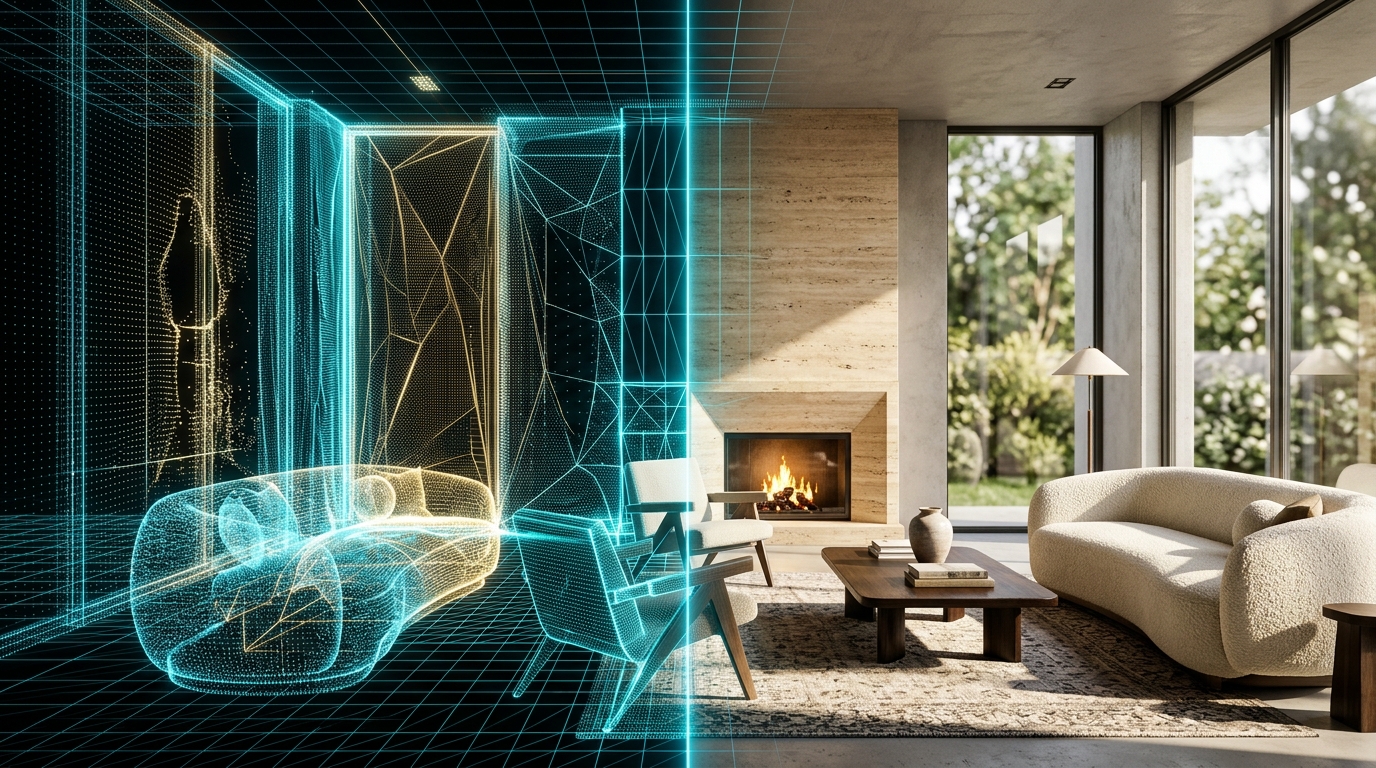
Minimalism in residential interior architecture is frequently misunderstood as an exercise in austere deprivation—a clinical white box stripped of human warmth, tactile pleasure, and historical context. In truth, authentic contemporary minimalism represents the absolute opposite: a rigorous, sensory-rich philosophy of living that elevates space, light, and material craftsmanship by ruthlessly eliminating visual noise and unconsidered mass-produced clutter.
When executed with architectural discipline, minimalist home decor essentials are not merely decorative accessories placed upon tables; they are carefully weighted sculptural interventions. Each piece must carry visual gravitas, possess authentic tactile integrity, and justify its physical presence within the room's negative space. As legendary industrial designer Dieter Rams famously established through his ten principles, excellent design is "weniger, aber besser"—less, but better. In the contemporary home of 2026, this ethos has evolved into Warm Minimalism: a synthesis of Japanese Wabi-Sabi restraint, Nordic materiality, and Mediterranean earth tones that transforms a house into an emotionally grounding sanctuary.
The Warm Minimalist Decor Framework
Material Sincerity
Reject imitation veneers, synthetic foams, and faux-aged composites. Every object must honestly celebrate its raw physical nature—honed unsealed stone, solid end-grain timber, unlacquered living-finish metals, and vegetable-dyed organic fibres.
Architectural Proportion
Prioritize fewer, significantly larger sculptural pieces over clusters of small trinkets. A single 24-inch hand-thrown terracotta vessel commands the eye with monastic dignity, whereas six small decorative objects create visual static.
Negative Space (Ma)
Embrace unadorned wall planes and empty surface expanses as active design elements. The void is not unfinished canvas waiting to be filled; it is the vital architectural silence that allows chosen objects to resonate.
The 15 Non-Negotiable Minimalist Home Decor Essentials
To construct a warm minimalist environment that feels intentional, grounded, and enduring, an interior requires a rigorously curated foundation of objects. Below is the definitive architectural catalog of the fifteen essential decor elements, categorized by their spatial function, material composition, and psychological impact.
Category I: Sculptural Anchor Objects
1. The Monolithic Stone Plinth or Low Travertine Table
In traditional interiors, side tables and coffee tables are often fussy compositions of spindly turned legs, drawers, and lower shelves. In warm contemporary minimalism, the horizontal anchor must possess geological weight. A low-slung (12 to 14-inch height) block plinth crafted from Roman travertine, honed Nero Marquina, or Portuguese limestone anchors the seating cluster. Because of its monolithic mass, it does not interrupt visual sightlines across the room envelope, preserving expansive floor horizons while introducing ancient geological striations and natural surface pits.
2. Hand-Thrown Large-Scale Wabi-Sabi Stoneware Vessels
One of the most profound mistakes in amateur minimalism is the placement of tiny, store-bought mass-manufactured vases scattered across shelves. Authentic minimalism demands singular, large-scale ceramic interventions (minimum 16 to 28 inches in diameter or height). Sourced from independent ceramicists utilizing wood-fired kilns, these vessels celebrate intentional asymmetry, subtle glaze crackle, and raw earthen clay bodies. Placed on an unadorned console or directly on the timber floor in an architectural corner, a single wabi-sabi vessel captures low-angle natural light and injects human soul into clean geometric spaces.

3. The Architectural Floor Mirror with Concealed Shadow Reveals
Mirrors in minimalist interiors are not mere vanity checkpoints; they are optical windows that capture exterior sky conditions, reflect natural sunlight into dark corners, and visually double spatial depth. The quintessential minimalist mirror eschews ornate gilded frames and bevelled edges. Instead, specify an oversized (84 x 42 inch minimum) floor-standing mirror framed in ultra-slim (1/4-inch) blackened steel or raw brushed bronze, with an integrated recessed shadow reveal. Leaning with casual precision against a lime-washed wall, it acts as an architectural portal that anchors the vertical perimeter of the room.
4. A Singular Statement Branch or Ikebana Botanical Intervention
Traditional interior decoration often relies on dense, multicolored floral bouquets arranged in glass vases—compositions that quickly decay and introduce visual clutter. Contemporary minimalism replaces multi-bloom arrangements with the contemplative discipline of Japanese Ikebana or a single architectural botanical branch. A dried quince bough, a sculptural fig branch, a twisted olive cutting, or preserved lotus seed pods display dramatic silhouette lines and seasonal transience without color chaos.
Category II: Ambient Illumination Luminaires
5. Japanese Washi Paper Lanterns (The Noguchi Legacy)
Architectural minimalism rejects harsh direct illumination from exposed incandescent bulbs or aggressive overhead spotlights. The ultimate luminaire of warm minimalism remains the lightweight washi paper lantern, pioneered by Isamu Noguchi with his Akari light sculptures. Crafted from mulberry bark paper stretched over delicate bamboo ribbing, these luminaires do not direct light downward; they swallow harsh lumens and gently exhale a spherical, weightless halo of 2200K–2500K warm glow that softens human skin tones and wraps minimalist architectural angles in serene atmospheric calm.
6. Cast Bronze or Turned Brass Heavy Candleholders
Living flame represents the most primal, comforting form of light known to architecture. A minimalist interior honors this through solid, heavy metallic candleholders. Choose cast unlacquered bronze, raw sand-cast iron, or brushed brass that has been left uncoated so it develops a rich natural patina through touch and oxidation. Paired with pure beeswax taper candles—which burn with a natural golden hue and subtle honey aroma rather than synthetic petrochemical fragrances—these objects provide quiet tactile ritual during evening hours.
7. Concealed Plaster Up-Light Sconces (Integrated Wall Luminaires)
When vertical wall lighting is required, warm minimalism avoids decorative sconces featuring fabric shades or exposed wiring. Instead, specify monolithic cast-plaster curved sconces that are troweled directly into the wall surface and painted or limewashed with the exact same mineral pigment as the wall envelope. When switched on, the luminaire disappears entirely, casting a soft sculptural scallop of indirect light upward across the ceiling plane and highlighting the subtle textural grain of the plaster wall.
Category III: Tactile Textiles & Acoustic Dampening
8. Hand-Knotted High-Density Undyed Natural Wool Rugs
In minimalist spaces featuring polished micro-cement, smooth hardwood, or limestone slabs, hard surfaces bounce soundwaves, creating harsh acoustic echoes. A substantial area rug is therefore both an architectural acoustic absorber and the physical foundation of the living envelope. The essential minimalist rug is crafted exclusively from undyed New Zealand or Tibetan virgin sheep's wool, showcasing the animal's natural tonal variations ranging from warm cream and oatmeal to silvery taupe. Eschewing busy oriental or geometric printed patterns, it relies entirely on high-low textural looping, sheared pile gradients, and rich lanolin content for visual depth and luxurious barefoot tactility.
9. Heavyweight Pure Belgian Linen Ripple-Fold Drapery
Windows in minimalist residences should not be choked with fussy swags, valances, or layered jacquards. The minimalist gold standard is floor-to-ceiling sheer or semi-sheer Belgian linen drapery installed on concealed ceiling pocket tracks with architectural ripple-fold carriers. Specified in double-width yardage that pools gently (1 to 2 inches) onto the hardwood floor, unlined natural linen filters aggressive direct midday solar glare into a soft, dreamlike ambient haze while preserving exterior landscape silhouettes and moving gently with room airflow.
10. Organic Textured Alpaca, Cashmere, or Bouclé Throws
Minimalist sofas risk feeling cold if left entirely unsoftened. However, instead of cluttering a curved modular sofa with eight printed throw pillows, the minimalist designer drapes a singular, exquisitely textured oversized throw blanket across one arm or seat cushion. Woven from unbleached baby alpaca, raw heavy-weight cashmere, or high-tactility bouclé wool, this functional layer invites physical relaxation while introducing nuanced micro-shadows across monochromatic upholstery.
Category IV: Functional Objects & Curated Accents
11. The Sculptural Timber Stool or Milking Bench
Pioneered by 20th-century modernist icons Charlotte Perriand and George Nakashima, the compact solid timber stool is the ultimate multi-functional minimalist element. Carved from a solid block of quarter-sawn white oak, fumed walnut, or charred cedar (Shou Sugi Ban), this versatile piece functions interchangeably as an extra conversational seat, a bathtub side table for bath oils, a bedside book rest, or an artistic plinth for an unglazed ceramic vessel. Its compact organic profile breaks the rigid orthogonal lines of contemporary rooms.
12. Architectural Art Monographs as Horizontal Composition
Minimalists do not display collections of plastic trinkets, souvenir mugs, or commercial knick-knacks. Instead, the horizontal planes of coffee tables and low consoles are composed with curated stacks of heavyweight architectural monographs. Bound in neutral matte linen and heavy uncoated paper stock—celebrating masters like Tadao Ando, Peter Zumthor, Axel Vervoordt, or John Pawson—these volumes serve a dual purpose: their typography and binding provide subtle graphic structure, while their contents offer guests timeless intellectual and aesthetic contemplation.
13. End-Grain Solid Hardwood and Honed Slate Serving Boards
In the kitchen and dining zones, minimalist home decor essentials bridge the boundary between utilitarian gastronomy and sculptural art. A thick, end-grain walnut cutting slab or a rough-hewn slab of Welsh dark slate propped against a seamless marble backsplash adds immediate organic gravitas. These boards are not hidden inside cupboards; their substantial weight, knife scars, and oiled timber patina celebrate the daily ritual of food preparation as an authentic aesthetic experience.
14. Stealth Saddle-Leather or Smoked Oak Storage Boxes
Modern daily life generates functional clutter: television remotes, charging cables, house keys, reading glasses, and mail. The minimalist solution is never to leave these scattered across countertops, nor to hide them in inconvenient distant drawers. Instead, deploy architectural containment boxes crafted from thick vegetable-tanned bridle leather, saddle-stitched by hand, or smoked oak boxes featuring flush magnetic lids. These containers conceal technology completely while contributing luxurious leather-goods craftsmanship to consoles and side tables.
15. A Singular Monumental Textured Canvas (Raw Plaster or Linen Impasto)
Rather than populating walls with a noisy gallery grid of twelve small photo frames, the minimalist interior anchors an entire room with one monumental artwork (minimum 60 x 80 inches). Contemporary minimalist art focuses on texture, materiality, and light absorption rather than figurative representation. Artworks crafted with layered gesso, raw slaked lime plaster impasto, hand-woven unprimed jute, or subtle charcoal pigments interact dynamically with morning and evening light, transforming the entire wall into an evocative, contemplative architectural plane.
Material Integrity: Why Authentic Stone, Solid Wood, and Living Metals Dictate Longevity
In heavily decorated traditional spaces, ornamental moldings, wallpaper patterns, and layered knick-knacks distract the human eye from substandard construction materials. In minimalist interior architecture, however, there is nowhere to hide. Because surfaces are expansive and furnishings are sparse, every material is scrutinized under intense natural light. Therefore, the foundational law of minimalist home decor is uncompromising material authenticity.
| Material Class | Recommended Architectural Specification | Aesthetic & Sensory Contribution | What to Strictly Avoid |
|---|---|---|---|
| Natural Stone | Honed Roman Travertine, Portuguese Limestone, Calacatta Viola, Pietra Serena | Geological permanence, thermal mass, matte light diffusion without synthetic reflection | High-gloss polished granite, printed porcelain faux-marble tiles |
| Hardwood Timbers | FSC-Certified French White Oak, American Black Walnut, Charred Cedar (Shou Sugi Ban) | Organic warmth, open grain tactility, micro-cellular acoustic dampening, graceful aging | Plastic laminate veneer, orange-tinted polyurethane glossy clearcoats |
| Living Metals | Unlacquered architectural bronze, hand-brushed raw brass, sandblasted gunmetal steel | Evolving patina that records human touch over decades; authentic industrial gravitas | Faux electroplated brass paint, mirror-polished bright chrome |
| Mineral Plasters | Slaked lime plaster (Venetian marmorino), Roman clay, natural micro-cement | Breathable, non-toxic VOC-free envelope; absorbs specular glare; soft cloud-like mottling | Standard synthetic vinyl-latex drywall paint, peel-and-stick vinyl wallpaper |
| Natural Textiles | Long-staple Belgian linen, undyed Tibetan wool, raw silk bouclé, vegetable-tanned leather | Irregular slub texture, acoustic insulation, breathable moisture regulation, soft draping | 100% polyester velvets, acrylic fleece throws, printed polyester jacquards |
The Chromatic Blueprint: Neutrals with Depth, Undertones, and Pigment Resonance
A widespread fallacy surrounding minimalist decor is that the palette must be restricted to sterile clinical white. In reality, pure optical white (often formulated with synthetic blue titanium pigments) induces eye strain, reveals every speck of dust, and casts an icy, unwelcoming pallor over residential spaces. Architectural warm minimalism relies instead on a layered tonal spectrum of warm, mineral-grounded neutrals.
When selecting pigments for minimalist walls, millwork, and decor accents, consider how the natural solar path interacts with color temperature throughout the day:
- Cremèle & Warm Bone: Formulated with yellow ochre and raw umber pigments, these warm alabaster tones mimic the luminous qualities of unbleached parchment. In north-facing rooms with cool, bluish daylight, cremèle neutralizes chilliness without reading as yellow.
- Chamois & Raw Oatmeal: Rich, earthy mid-tones that echo the texture of natural linen fibers. Ideal for upholstered seating, wool area rugs, and heavy drapery, establishing a tactile baseline that feels intrinsically grounded.
- Smoked Taupe & Greige: A sophisticated hybrid of grey and warm beige with subtle violet-brown undertones. These tones provide enough contrast against bone-white walls to articulate architectural reveals and custom millwork niches.
- Deep Earth Accents (Charcoal Basalt & Burnt Umber): Minimalist palettes require grounding contrast to prevent spaces from feeling floaty or washed out. Use deep blackened umber, oxidized bronze, or charcoal basalt sparingly—a door handle, a picture frame, a sculptural side chair—to draw a crisp visual datum line through the space.
The Art of "Negative Space": Architectural Ma, Horizon Lines, and Breathing Room
In traditional Western interior decorating, an empty wall or bare tabletop is viewed as an omission—a vacuum demanding to be filled with mirrors, plates, or decorative knick-knacks. In contemporary minimalist philosophy, drawn heavily from the Japanese architectural concept of Ma (間), negative space is understood as an active, potent design element.
Ma represents the pregnant pause between notes in a musical composition; it is the physical and psychological interval that gives meaning to the objects surrounding it. When an expansive 16-foot lime-washed living room wall displays only a single, delicately balanced bronze wall luminaire and an unadorned floating oak bench, the eye does not perceive emptiness. Instead, the mind experiences profound relief from sensory saturation.
To cultivate authentic negative space in your home, apply three architectural rules:
- The 60/40 Surface Ratio: On any horizontal surface—whether a kitchen island, a dining table, or a bedroom dresser—ensure that at least 60% of the surface area remains completely bare of objects. The remaining 40% should accommodate a single, intentional group of three curated items of varying heights.
- Protect the Sightline Horizons: Keep low-slung furnishings (sofas, benches, coffee tables) below 28 inches in overall height in open-plan areas. This allows the human gaze to travel unimpeded from the room entrance across the floorplate and directly through exterior window glazing to the outdoor landscape.
- The 48-Hour De-accession Test: If you introduce a new decor object into a room, temporarily remove another item for 48 hours. If the room feels calmer and more composed during its absence, permanently de-accession the removed object to preserve spatial equilibrium.
Room-by-Room Minimalist Curation Playbook
Translating minimalist philosophy into physical reality requires specific, room-by-room tactical execution. A living room demands different sensory considerations than an intimate bedroom or a high-traffic entryway. Below is our comprehensive studio playbook for curating minimalist decor across every major residential zone.
1. The Minimalist Living Room: The Contemplative Gathering Horizon
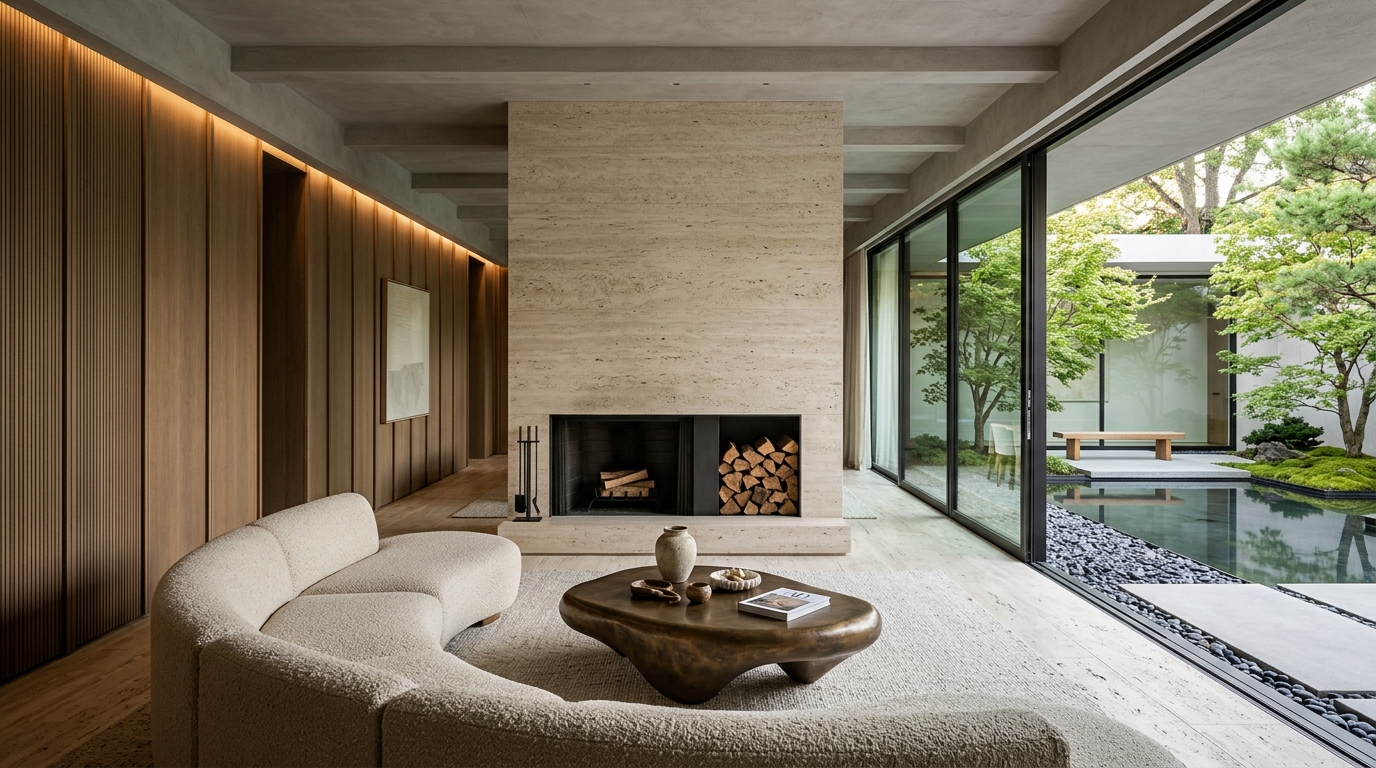
The living room is frequently the most cluttered space in contemporary homes, victim to excessive cushions, discarded electronics, coffee table knick-knacks, and overlapping side tables. In a warm minimalist living room, the space is conceived as a low, horizontal landscape where sightlines remain entirely uninterrupted.
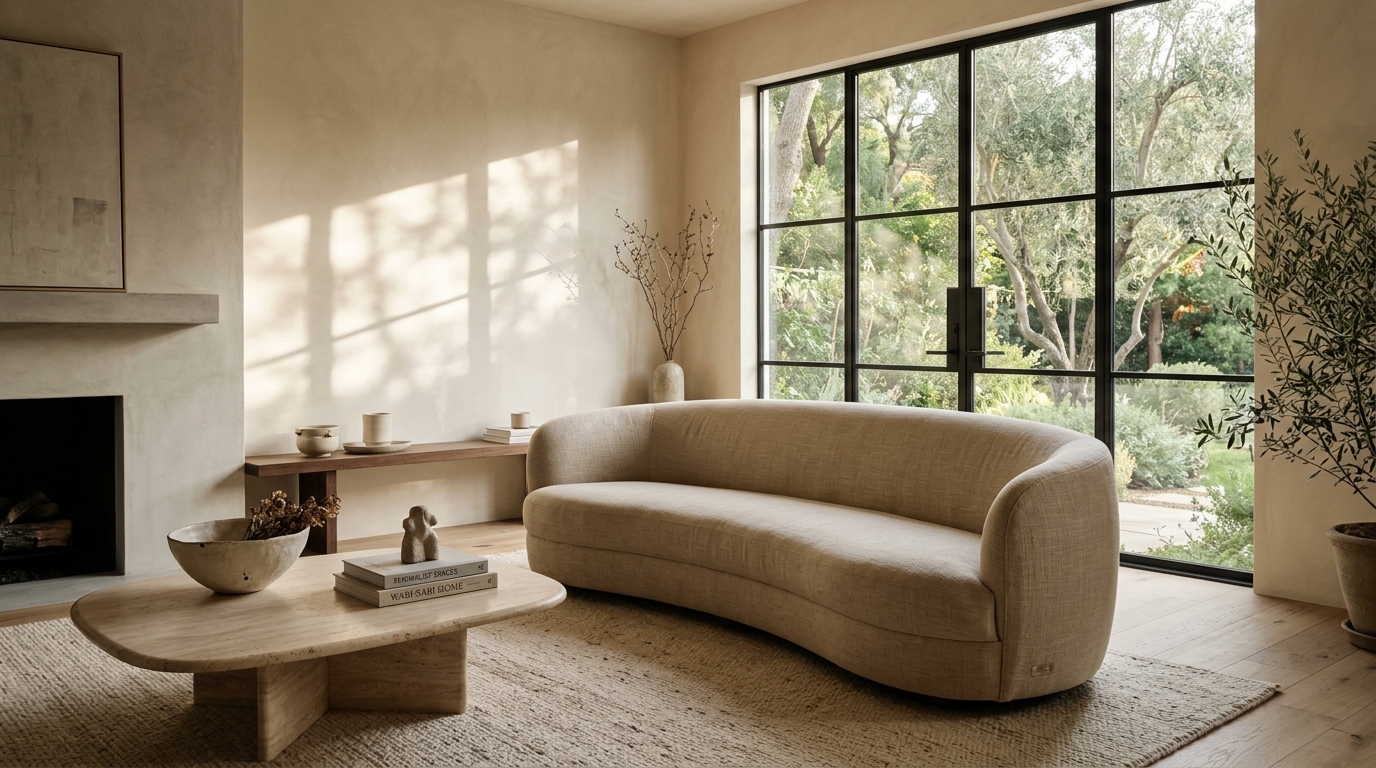
- Furnishing Core: A single, monolithic low-slung curved sofa upholstered in natural oatmeal textured linen or durable bouclé, accompanied by one sculptural timber or leather lounge chair (such as an iconic Pierre Jeanneret or Hans Wegner easy chair).
- Table Curation: A low honed Roman travertine or smoked oak block plinth. The tabletop curation is restricted to three items: one heavy matte art monograph (e.g., Axel Vervoordt's Wabi Inspirations), a hand-carved soapstone or ceramic bowl for functional storage, and a single cast bronze candleholder.
- Floor Architecture: A massive, room-spanning undyed wool rug that encompasses the entire footprint of the seating grouping, leaving an intentional 14-inch perimeter border of exposed hardwood flooring.
- Vertical Envelope: One expansive wall left completely bare except for a delicate wash of warm 2700K indirect LED cove light; the opposite wall anchored by a singular monumental textured canvas or an unadorned architectural fireplace hearth.
2. The Minimalist Dining Sanctuary: Ritual and Craftsmanship
Dining rooms in traditional houses often feature ornate buffets, glass display china cabinets, and elaborate floral centerpieces. A minimalist dining room strips away decorative distraction, elevating the human ritual of gathering and sharing meals to a near-ceremonial status.
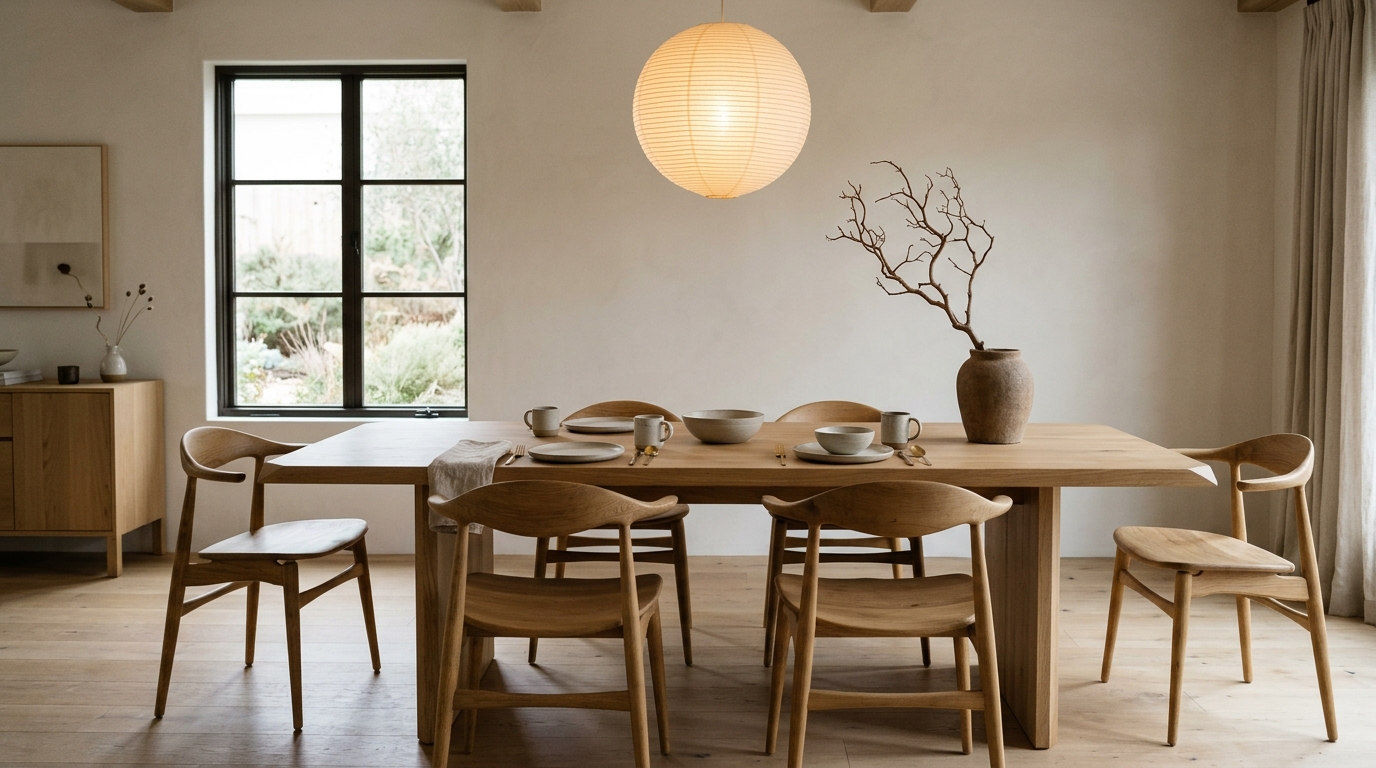
- The Table: A monolithic solid white oak or walnut refectory table with honest joinery details and a soft chamfered edge. The natural wood grain must be finished in a matte, breathable UV-cured oil rather than a plastic lacquer coat.
- Seating: Sculptural, ergonomic solid wood dining chairs with paper cord or saddle-leather seating surfaces. Chairs should tuck cleanly under the table profile when not in use.
- Centerpiece Philosophy: Never specify permanent plastic or silk flower arrangements. When the table is not set for dining, it remains 90% bare, anchored solely by a solitary hand-thrown earthen vase holding a sculptural dried branch or a solitary raw iron fruit bowl.
- Illumination: A single, low-hung oversized Japanese washi paper pendant (such as Noguchi's Akari 55A or 70F) suspended exactly 32 to 34 inches above the tabletop, creating an intimate canopy of warm golden light that pools over the dining surface.
3. The Minimalist Primary Bedroom: The Circadian Sleep Sanctuary
The bedroom is the intimate core of human recovery. Excessive visual stimuli, blinking LED indicators, and disorganized clothing induce elevated cortisol levels and disrupt circadian sleep rhythms. The minimalist bedroom is engineered as a sensory deprivation chamber for quiet restoration.
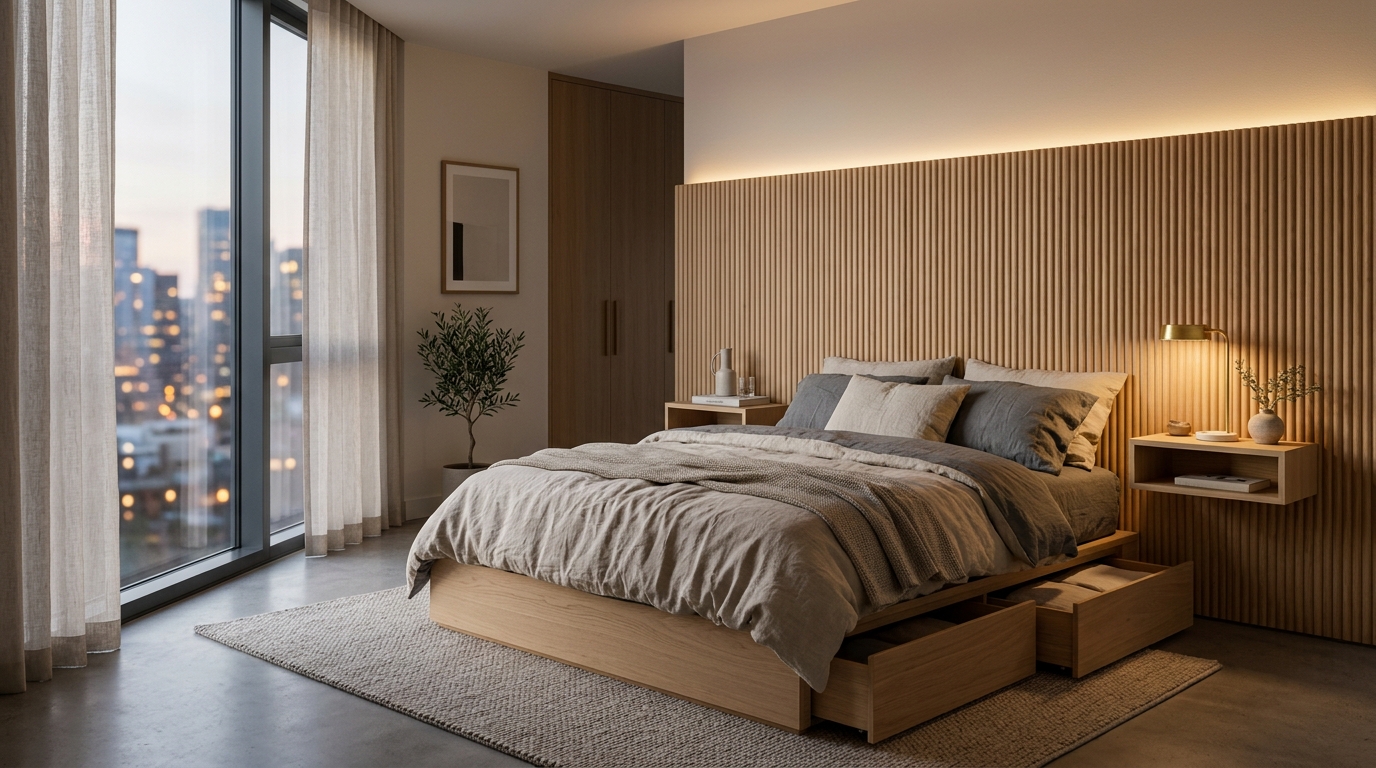
- The Bed Architecture: A low-profile platform bed frame crafted from solid European oak or upholstered in raw linen, with an integrated wall-to-wall floating headboard ledge that replaces bulky standalone nightstands.
- Bedding Curation: Pure washed Belgian linen sheets in unbleached flax, soft bone, or muted slate. Forego decorative "sham" pillows and complex multi-layered bed skirts; two plump sleeping pillows per person and a folded organic alpaca wool throw blanket at the foot of the bed provide luxurious comfort without morning chore rituals.
- Lighting: Wall-mounted minimalist swing-arm reading sconces in patinated brass, paired with concealed perimeter headboard backlighting emitting dimmable 2200K amber glow. No direct ceiling downlights above the sleeping horizon.
- Fenestration: Motorized dual-track pocket drapery: an inner sheer linen curtain for soft daytime daylight filtering, paired with an outer concealed acoustic blackout roller shade for complete nighttime sensory darkness.
4. The Minimalist Foyer & Entryway: The Threshold Transition
The threshold of a residence sets the psychological tone for the entire interior. A cluttered entryway crowded with shoe piles, coats on hooks, and unorganized mail immediately induces cognitive stress upon crossing the front door.
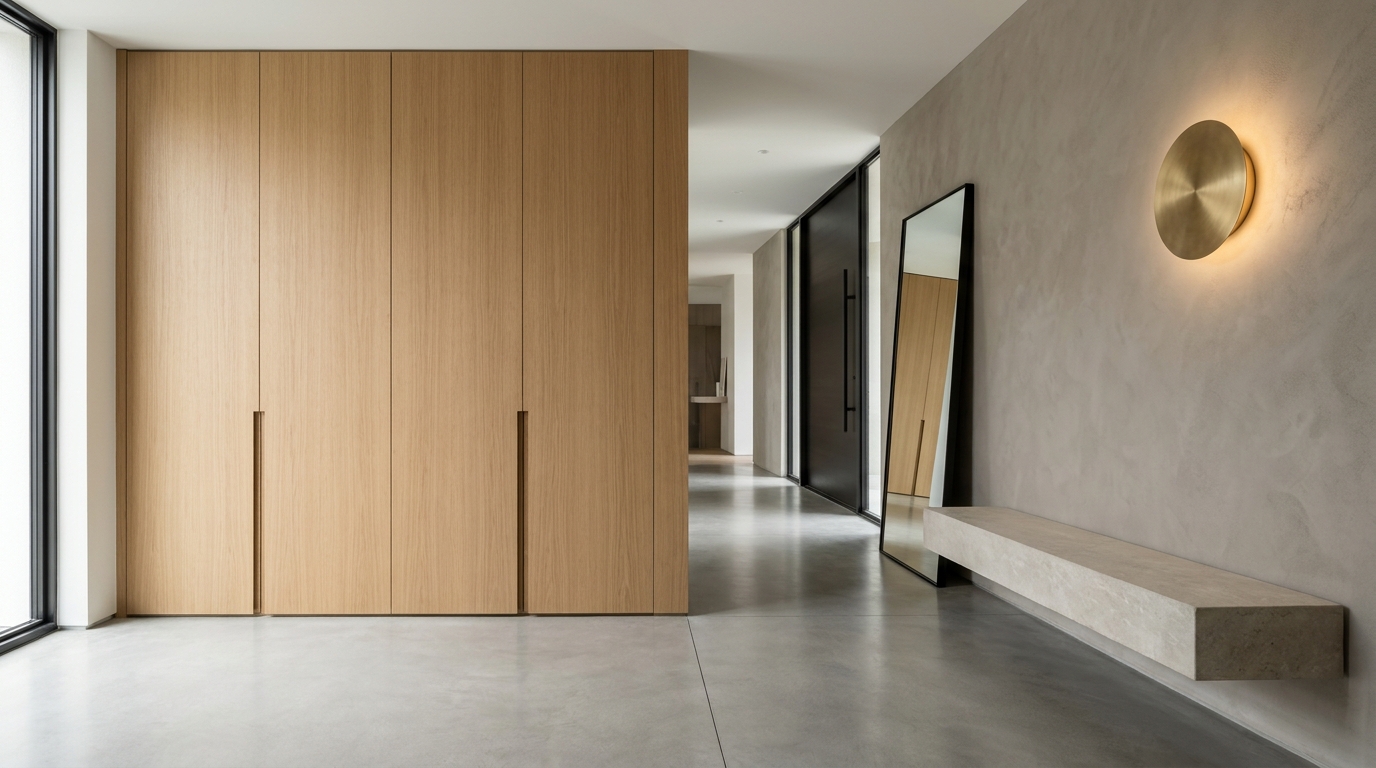
- Concealed Architecture: Floor-to-ceiling flush millwork panels with concealed touch-latches or integrated finger pulls that house shoes, coats, umbrellas, and luggage entirely out of sight.
- The Sculptural Threshold: A single, cantilevered floating bench crafted from a solid slab of honed Portuguese limestone or rift-cut oak, propped against a smooth Roman clay wall.
- Sensory Welcome: A solitary, cast bronze or ceramic catchall dish for car keys, paired with an unglazed ceramic incense burner or natural beeswax candle on a floating niche shelf, providing a subtle olfactory transition into the home.
- Visual Axis: An oversized leaning blackened steel mirror that reflects outdoor natural light and captures an architectural vista into the main living pavilion.
5. The Minimalist Spa Bathroom: Tactile Hydrotherapy
Commercial shampoos, brightly colored plastic soap dispensers, and mismatched towels turn modern bathrooms into sensory billboards. Minimalist bathroom decor transforms the wet room into a monolithic stone sanctuary.
- Monolithic Surfaces: Large-format honed limestone floor slabs paired with seamless waterproof micro-cement walls and curbless zero-threshold walk-in shower enclosures.
- Vanity Discipline: Floating stone or oak vanity with deep, push-to-open soft-close drawers that house hair dryers, toiletries, and skincare out of view. The countertop displays only a single refillable amber glass or stone pump bottle of organic hand soap and a single rolled organic waffle-weave linen hand towel.
- Bathtub Architecture: A freestanding matte white resin or composite stone soaking tub accompanied by a small solid wood milking stool holding a natural sea sponge and a single vessel of bath salts.
De-Cluttering Psychology & Stealth Joinery: The Architectural Storage Paradigm
True architectural minimalism is not maintained through continuous domestic anxiety or unrealistic lifestyle rigidity. If a minimalist home requires hours of daily tidying just to look presentable, the spatial design has fundamentally failed. The secret to effortless minimalism is stealth joinery—architectural built-in storage engineered so deeply into the wall envelope that living functions remain pristine without friction.
The Psychological Weight of Visual Noise
Neuroscientific research conducted by the Princeton Neuroscience Institute confirms that multiple visual stimuli within an individual's visual field compete for neural representation in the visual cortex. In simple terms: physical clutter constantly exhausts your brain's cognitive bandwidth, elevating baseline cortisol production and diminishing capacity for deep focus. By eliminating extraneous decorative items and concealing utility items behind architectural surfaces, a home actively restores the resident's neurological calm.
To implement the architectural storage paradigm, specify the following structural interventions:
- Full-Height Floor-to-Ceiling Millwork: Never stop cabinetry 12 to 18 inches below the ceiling where dust collects and visual lines break. Run cabinetry flush to the ceiling with recessed shadow reveals, turning the cabinetry wall into a clean architectural plane.
- Appliance Garages & Pocket Bi-Fold Doors: In kitchens and coffee bars, conceal toasters, espresso machines, and blenders behind bi-folding pocket doors that slide away during morning preparation and close flush when breakfast is finished.
- Sub-Floor and Perimeter Wire Concealment: Integrate floor-mounted electrical boxes beneath sofas and run low-voltage conduit channels behind drywall reveals to eliminate trailing power cords for lamps, chargers, and entertainment displays.
- Concealed Flush Utility Niches: Recess bathroom medicine cabinets, laundry hampers, and ironing stations completely inside standard 2x6 wall stud cavities with touch-release mirrored panels that sit flush with the surrounding plaster.
The 70/20/10 Curatorial Rule for Timeless Minimalist Decor
One of the greatest dangers in minimalist interior design is ending up with a space that resembles an impersonal corporate lobby or a cold showroom catalog. When everything in a room is bought brand new from a single designer brand, the interior lacks historical tension, texture, and narrative depth.
To avoid this, Rowui designers employ the 70/20/10 Curatorial Rule:
Architectural Foundation
The foundational envelope and primary furniture: custom floor-to-ceiling joinery, monolithic stone countertops, large-format flooring, clean architectural sofas, and bespoke linen drapery. This layer is timeless, neutral, and permanent.
Collectible Mid-Century Vintage
Pieces with historical pedigree and authentic patina: an original 1950s Charlotte Perriand stool, an Afra and Tobia Scarpa Soriana lounge, a brutalist bronze table lamp, or a vintage Scandinavian timber sideboard. These introduce sculptural charisma and investment value.
Primitive & Organic Artifacts
One-of-a-kind handmade artifacts: a 19th-century hand-carved grain bowl, an unglazed wabi-sabi Japanese raku pot, an organic olive burl sculpture, or a singular dried branch. These elements inject raw human soul and celebrate imperfection.
The 8 Fatal Minimalist Decor Mistakes (And How to Avoid Them)
Because minimalist spaces rely on sparse arrangements and uncluttered horizons, every single mistake is immediately visible. Traditional styles can hide flaws behind patterned wallpaper, thick trims, and clustered accessories; minimalism exposes every seam, proportion, and tonal discord. Below are the eight most frequent mistakes encountered in minimalist home decor projects, paired with their definitive architectural fixes.
1. The High-Gloss Optical White Trap
The Error: Specifying stark brilliant white latex paint across all drywall surfaces, believing that white equals minimalism. The room ends up feeling like a dentist's operatory or an industrial laboratory, casting cool greenish-blue shadows that drain vibrancy from furnishings and human complexions.
The Correction: Switch to mineral-based Roman clay, slaked lime wash, or flat chalk-emulsion paints formulated with warm bone, raw alabaster, or chamois undertones. These mineral coatings absorb harsh direct sunlight and diffuse it into a warm, velvet-like luminescence.
2. The Scale & Proportion Trap (Scattered Small Trinkets)
The Error: Purchasing dozens of small 4-to-8-inch decorative items (candles, tiny potted succulents, miniature figurines) and scattering them across shelves and coffee tables. This does not create minimalism; it creates visual static and dust traps.
The Correction: Consolidate your decor budget. Replace ten small decorative objects with a single monumental 24-inch hand-thrown ceramic vessel, an oversized 8-inch thick stone plinth, or an expansive textured canvas. Fewer, larger objects command spatial dignity and quiet the room.
3. The Postage-Stamp Floating Rug Miscalculation
The Error: Buying an undersized 5x8 or 6x9 foot rug that sits isolated in the middle of a seating cluster, with only coffee table legs or sofa front feet resting upon it. This breaks the spatial continuity of the floorplate, making expansive rooms look cramped and disjointed.
The Correction: Size the rug so that every piece of furniture in the conversational cluster sits completely on top of it. In a generous living room, specify a custom 10x14 or 12x16 foot high-density wool rug, leaving an intentional 12-to-18-inch border of exposed timber flooring around the room perimeter.
4. Monolithic Texture Deprivation
The Error: Maintaining a completely flat, non-tactile environment: smooth drywall, flat painted cabinetry, smooth leather sofas, and thin synthetic drapery. Without texture, a neutral palette feels lifeless, synthetic, and flat.
The Correction: Layer contrasting textural densities: pair smooth honed limestone with rough unglazed ceramics; offset flat slaked lime walls with tactile bouclé wool and heavy slubbed Belgian linen; introduce wire-brushed open-grain European oak alongside sandblasted gunmetal steel.
5. The Swiss-Cheese Recessed Downlight Grid
The Error: Puncturing pristine ceiling planes with an aggressive geometric grid of bright recessed downlights. This washes spaces with unflattering vertical shadows and excessive glare, destroying the contemplative mood of the interior.
The Correction: Eradicate high-angle general ceiling grids. Specify perimeter cove lighting reveals, low-level floor lamps, wall-integrated plaster uplights, and low-hung sculptural paper or fabric pendants equipped with warm 2200K–2700K high-CRI (98+) LED emitters.
6. Severe Acoustic Neglect
The Error: Creating an echo chamber. When minimalist spaces combine concrete or tile floors with vast glass windows and minimal upholstery, every footstep, dropped spoon, or spoken word reverberates loudly, causing chronic sensory fatigue.
The Correction: Embed acoustic dampeners directly into the architecture: double-thickness unlined linen drapery pooling on floors, acoustic felt backing behind slatted wood accent walls, dense wool rugs with dual-felt underlays, and micro-perforated acoustic plaster on ceilings.
7. Over-Indexing on Fast-Furniture Social Media Micro-Trends
The Error: Filling a home with cheap, mass-market copies of viral social media fads: bubbly cartoonish seating, squiggly pastel mirrors, faux-terrazzo resin accessories, or checkerboard patterns. Within two years, these pieces look hopelessly dated.
The Correction: Invest in enduring design icons and authentic natural materials with proven 50-year lifecycles: solid oak, unpolished travertine, raw linen, and certified 20th-century modernist collectible furniture that retains or appreciates in value.
8. Disregarding Contextual Vernacular and Solar Orientation
The Error: Blindly copying a Scandinavian or Mediterranean minimalist Pinterest image without considering your building's geographic location, natural solar light quality, or surrounding environment.
The Correction: In cool northern climates with grey winter light, introduce deeper timber tones (fumed oak, walnut), warm woolens, and creamy plaster undertones. In hot sun-drenched desert or coastal regions, embrace cool limestone, raw linen, and deep architectural overhangs that temper direct glare.
Minimalist Decor Investment Guide: Where to Spend vs. Where to Conserve
Executing high-end warm minimalism does not require unlimited capital; it requires strategic architectural allocation. Allocate your investment where physical contact, eye-level gaze, and structural permanence matter most, while conserving budget on non-critical secondary surfaces.
| Category | Where to Allocate Budget (High Investment) | Where to Conserve Budget (Strategic Savings) |
|---|---|---|
| Foundational Seating | Custom modular sofa with solid kiln-dried hardwood frame, high-density natural down cushions, and heavy Belgian linen or wool bouclé upholstery. This piece anchors your daily life for 15+ years. | Accent side seating: source authentic restored vintage bentwood chairs or mid-century timber stools at estate auctions rather than paying new luxury retail markups. |
| Floor Coverings | Large-scale hand-knotted 100% unbleached virgin sheep's wool rug. The tactile feel underfoot and acoustic dampening cannot be faked with synthetic fibers. | Secondary utility mats: unlined natural jute or sisal runners for hallways and pantries provide excellent organic texture at a modest cost. |
| Luminaires & Lighting | Authentic statement pendants (such as an original Isamu Noguchi Akari lantern) and high-CRI (98+) commercial-grade architectural LED drivers with smooth 0.1% dimming curves. | Concealed cove profiles: aluminum LED channel extrusions and standard plaster up-light housings are inexpensive commodity hardware once installed and skim-coated flush. |
| Tableware & Ceramics | A single monumental 20-to-28-inch hand-thrown wabi-sabi vessel from a regional studio ceramicist to serve as the sculptural focal point of the room. | Everyday ceramic tableware: simple, unglazed matte stoneware plates and bowls from ethical artisan collectives or Japanese home goods purveyors. |
| Window Fenestration | Double-width custom unlined sheer Belgian linen drapery with concealed ceiling ripple-fold pocket hardware. Beautiful drapery transforms ordinary drywall into luxury architecture. | Secondary room roller blinds: standard architectural motorized blackout cassette blinds concealed inside ceiling pockets perform identically to ultra-luxury branded shades. |
Frequently Asked Questions: Minimalist Home Decor Decoded
1. How do you make minimalist home decor feel warm instead of cold and institutional?
The secret to warmth in minimalism lies in replacing synthetic surfaces and cool-toned greys with organic materiality. Specify warm mineral plasters (such as Roman clay or slaked lime in cremèle and bone hues), open-grain French oak flooring with matte oil finishes, high-pile undyed wool rugs, pure Belgian linen drapery, unlacquered living-finish brass hardware, and warm 2200K–2700K indirect lighting. Warmth is engineered through tactile depth, not through decorative clutter.
2. How many decorative objects should be displayed in a minimalist room?
As a general architectural rule, follow the Rule of Three applied to singular focal zones. On a coffee table or console, display no more than three intentional objects of varying scale and texture (for example: one heavy art monograph, one ceramic wabi-sabi bowl, and one sculptural bronze candleholder). Furthermore, at least 60% of all horizontal surfaces should remain entirely clear of objects to preserve visual breathing room.
3. Is minimalist home decor practical for families with children or pets?
Yes—in fact, when properly designed, minimalism is significantly more practical for families because it eliminates hundreds of breakable trinkets, dust-collecting knick-knacks, and carpet traps. The key is stealth built-in joinery: deep floor-to-ceiling cabinetry where toys, school supplies, and pet gear can be rapidly stowed behind flush touch-latch panels. For upholstery, specify performance linens, durable bouclés treated with non-toxic stain repellents, and natural oiled hardwood flooring that can be spot-repaired without refinishing entire rooms.
4. What is the difference between Minimalist decor and Japandi decor?
Japandi is a specific stylistic sub-branch of warm minimalism that explicitly merges Scandinavian functional modernism with traditional Japanese Wabi-Sabi philosophy. While pure architectural minimalism can encompass sharp industrial materials (such as raw concrete, blackened steel, and monumental stone), Japandi leans heavily into warm natural craftsmanship, low-to-the-ground tatami proportions, pale cedar and white oak, paper shoji-inspired washi lighting, and rustic organic ceramics.
5. How do I start decluttering my home toward a minimalist aesthetic without feeling overwhelmed?
Begin with the "Clear Horizon" quarantine method. Pick a single room—ideally the primary bedroom or living room. Clear every decorative object, picture frame, candle, and pillow off all horizontal surfaces and walls into boxes and store them in a closet for 14 days. Live in the stripped-down space. You will immediately experience psychological decompression. After two weeks, only re-introduce items that possess genuine functional necessity or extraordinary sculptural beauty. Donate or re-home the remaining items.
6. What type of artwork works best in a minimalist home?
Minimalist architecture thrives on singular, large-scale textural works rather than busy gallery walls of small framed photographs. Look for large unprimed canvases featuring textural slaked lime plaster impasto, minimal charcoal geometric gestures, raw woven hemp textiles, or architectural black-and-white photographic prints float-mounted in ultra-slim unornamented timber or blackened steel frames.
7. How do I handle cords, television screens, and electronics in minimalist decor?
Integrate technology into the architectural envelope. Recess television screens flush into millwork niches or utilize art-mode displays (such as the Samsung Frame with custom architectural timber bezels). Run all HDMI and audio cables through in-wall low-voltage conduit boxes to a remote joinery cabinet equipped with an infrared repeater. Use floor-recessed electrical outlets beneath sofas to power table lamps without trailing surface cords.
8. Can I mix different wood tones in a minimalist home?
Yes, provided there is a dominant architectural species that anchors 70% of the interior (e.g., French white oak flooring and millwork). You can introduce secondary timber accents—such as a dark fumed walnut coffee table, a charred cedar milking stool, or a vintage teak lounge chair—as intentional contrasting sculptural notes. Avoid mixing competing woods that have clashing artificial orange or red polyurethane stains; ensure all wood species share a matte, open-grain, oil-finished surface texture.
9. What are the best indoor plants for a minimalist aesthetic?
Avoid clusters of small potted plants scattered across window sills, which look chaotic. Instead, specify a single, tall, architectural specimen in a large cylindrical unglazed earthenware pot or cast-stone planter. Excellent architectural varieties include an olive tree (Olea europaea), a fiddle-leaf fig (Ficus lyrata) pruned to a singular sculptural stem, a dragon tree (Dracaena draco), or a Japanese maple (Acer palmatum) positioned near a floor-to-ceiling glass window.
10. Is high-end minimalist decor more expensive to achieve than other styles?
While minimalist decor requires fewer total pieces, each piece must meet higher standards of craftsmanship, joinery, and material sincerity. In traditional decorating, inexpensive synthetic materials can be masked by ornate profiles, fringes, and printed patterns; in minimalism, a cheap laminate surface or faux-brass plating is immediately obvious. However, because you purchase fewer items that endure for decades without succumbing to trend obsolescence, the long-term cost-per-year of warm minimalism is significantly lower.
Conclusion: Crafting a Home of Lasting Quietude
Minimalist home decor essentials are ultimately about honoring your mental clarity and elevating your daily rituals. By letting go of superficial decorative clutter and investing in enduring natural materials—honed stone, honest timber, breathable linen, living metals, and warm indirect illumination—you transform your home into an authentic sanctuary that restores your spirit every time you cross the threshold.
Ready to Curate Your Minimalist Sanctuary?
Whether you are commissioning a new residential build, re-imagining a penthouse floorplate, or seeking bespoke architectural joinery that conceals daily clutter while celebrating monolithic stone and timber, Rowui provides complete end-to-end interior architecture and spatial curation.
Curated Interior Architecture Library, Wikipedia Lexicon & Visual Research
For interior architects, spatial designers, and commissioning clients seeking verified design history, material science standards, and high-resolution moodboards, explore our curated external research directory:
Interior Design Lexicon (Wikipedia)
- Interior Architecture Discipline
- Bauhaus Movement & Craft
- Mid-Century Modern Principles
- De Stijl Pure Abstraction
- Warm Brutalism & Concrete
- Wabi-Sabi Aesthetics
- Japandi Hygge Synthesis
- Memphis Postmodernism
- Art Deco Geometric Luxury
- Scandinavian Functional Design
- Architectural Minimalism
- Spatial Programming & Ergonomics
- Spatial Energy & Feng Shui
- Human-Centric Circadian Light
- Color Theory & Undertones
- Room Acoustics & NRC Ratings
- Low-VOC Indoor Air Quality
- Anthropometric Ergonomics
- Bespoke Architectural Millwork
- Architectural Woodwork Standards
- Venetian Poured Terrazzo
- Carrara & Calacatta Marble
- Roman Unfilled Travertine
- Moroccan Waterproof Tadelakt
- Venetian Slaked-Lime Plaster
- Engineered Quartz Slabs
- Large-Format Sintered Porcelain
- Engineered Hardwood Chevron
- American Black Walnut Joinery
- Rift-Sawn White Oak Veneers
- Heavyweight Wool Bouclé
- Pure Full-Grain Aniline Leather
- Pure Belgian Triple-Weave Linen
- Acoustic Cork Underlayment
- Natural Bio-Based Linoleum
- Mohs Hardness Countertop Testing
- ASTM C97 Porosity Standards
- Biophilic Spatial Well-Being
- Natural Daylighting Strategies
- Luminous Flux & Lux Calculations
- Color Rendering Index (CRI 95+)
- Correlated Color Temperature (2700K)
- High-Rub Count Upholstery
- Living Unlacquered Brass Patina
- Satin Surgical Stainless Steel
Curated Visual Boards (Pinterest)
- Contemporary Interior Architecture
- Warm Minimalist Living Rooms
- Japandi Interior Styling
- Small Bedroom Spatial Ideas
- Travertine Bathroom Sanctuaries
- Calacatta Viola Marble Islands
- Fluted Timber Wall Joinery
- Seamless Microcement Bathrooms
- Concealed Cove Ceiling Lighting
- Shadow-Gap Baseboard Details
- Curated Residential Art Displays
- Mid-Century Modern Living
- Warm Brutalist Loft Interiors
- Bespoke Couture Wardrobes
- Bouclé Furniture Textures
- Unlacquered Living Brass Hardware
- Floor-to-Ceiling Linen Drapes
- Monochrome Color Drenching
- Floating Cantilevered Staircases
- Modern Wine Tasting Vaults
- Crittall Steel Glass Partitions
- Roman Clay Plaster Finishes
- Modern Terrazzo Vanities
- Mezzanine Loft Bed Architecture
- Commercial Hospitality Lounges
- Acoustic Slat Wood Panels
- Dim-to-Warm Ambient Lighting
- Japandi Solid Wood Dining
- Concealed Minimalist Pantries
- Monolithic Stone Soaking Tubs
- Moody Cocooning Bedrooms
- Large-Scale Minimalist Art
- Low-Slung Architectural Sectionals
- Zoned Open-Plan Living
- Fully Integrated Appliance Walls
- Internal Atrium Olive Trees
- Architectural Linear AC Slot Diffusers
- Minimalist Plaster Fireplaces
- Floor-to-Ceiling Library Walls
- Sculptural Statement Lighting
Institutes & Technical Authorities
- American Society of Interior Designers (ASID)
- International Interior Design Association
- British Institute of Interior Design (BIID)
- International Federation of Interior Architects
- European Council of Interior Architects
- National Kitchen & Bath Association
- Intl. Association of Lighting Designers
- USGBC LEED Interior Design + Construction
- WELL Building Health Standards
- Cradle to Cradle Certified Materials
- UL GREENGUARD Low-Emissions Certification
- Forest Stewardship Council Joinery
- ArchDaily Interiors Directory
- Dezeen Interior Architecture
- Architectural Digest Publications
- Frame Magazine Spatial Design
- Wallpaper* Design & Interiors
- Domus International Spatial Culture
- Dwell Modern Home Design
- World Interiors News Awards
- Red Dot Product & Interior Awards
- iF Design International Awards
- Compasso d'Oro Italian Design
- ASTM Tile & Surface Standards
- ISO Acoustic Resonance Standards
Reference Links & Verified Digital Resources
Authoritative spatial tools, developer ecosystems, external architectural documentation, and partner directories:
- penggarisonline.blogspot.com
- penggarisonline.bolt.host
- penggarisonline.id
- penggarisonline.lovable.app
- penggarisonline.zite.so
- speakerdeck.com/penggarisonline
- penggarisonline.base44.app
- about.me/penggarisonline
- coub.com/penggaris-online
- gravatar.com/penggarisonline
- linktr.ee/penggarisonline
- mylinkhub.cc/penggarisonline
- vimeo.com/penggarisonline
- facebook.com/PenggarisOnline
- instagram.com/penggaris_online
- pinterest.com/penggarisonline
- quora.com/profile/Penggaris-Online
- reddit.com/user/penggarisonline
- tiktok.com/@penggarisonline
- tumblr.com/penggarisonline
- youtube.com/@PenggarisOnline
- solo.to/penggarisonline
- corriv.com/penggarisonline
- demo.larasocial.app/penggaris.online
- community.fandom.com/wiki/User:Penggarisonline
- independent.academia.edu/PenggarisOnline
- letterboxd.com/penggarisonline
- medium.com/@penggarisonline
- myanimelist.net/profile/penggarisonline
- scholar.google.co.in/citations
- seekingalpha.com/user/65134078
- substack.com/@penggarisonline
- atlasobscura.com/users/a659ab4e-15bd-4d95-...
- boredpanda.com/contributor/ruler
- dpreview.com/forums/members/penggaris-...
- goodreads.com/user/show/204538595-pengg...
- intensedebate.com/profiles/penggarisonline
- polygon.com/profile/GE129332
- sbnation.com/users/VRXoQY6BFF/penggari...
- slideshare.net/penggarisonline
- ted.com/profiles/52204510
- tripadvisor.com/Profile/penggarisonline
- wikihow.com/User:Penggaris-Online
- writeupcafe.com/author/penggarisonline
- wakelet.com/@PenggarisOnline
- profile.hatena.ne.jp/penggarisonline
- penzu.com/p/211280e39d596a9e
- penggarisonline.bluxeblog.com/76006774/cara-kalibrasi-p...
- payrchat.com/blogs/96862/apa-itu-ppi-k...
- ka-blogs.com/posts-list
- penggarisonline.fare-blog.com/448224/penggaris-online-d...
- naya.com.np/post/p1792315927ejefd
- diigo.com/item/note/c15pl/qkth
- penggarisonline.blogminds.com/cara-mengecek-ukuran-laya...
- share.evernote.com/note/74f23666-3cee-e718-b...
- instaconnect.co/read-blog/149962
- penggarisonline.aioblogs.com/96238471/cara-mengukur-uk...
- zekond.com/read-blog/408162
- medium.com/@penggarisonline/cara-men...
- webypost.com/cara-mengukur-ukuran-ceta...
- thefeedfeed.com/penggaris-online/articles...
- writeupcafe.com/cara-mengukur-ukuran-gela...
- penggarisonline.blogspot.com/2026/10/cara-mengukur-uku...
- alphacoders.com/users/profile/371831/peng...
- au.blurb.com/user/penggarisonl
- contra.com/penggaris_online_8fhnkfu8...
- creativemarket.com/users/penggarisonline
- my.archdaily.com/us/@penggaris-online
- my.archdaily.com/us/@penggaris-online/folders
- penggarisonline.bandcamp.com
- pixabay.com/users/penggarisonline-577...
- pxhere.com/en/photographer/5149838
- sketchfab.com/penggarisonline
- unsplash.com/@penggarisonline
- artstation.com/penggarisonline9
- behance.net/penggarisonline
- dreamstime.com/penggarisonline_info
- mixcloud.com/penggarisonline
- reverbnation.com/penggarisonline
- thingiverse.com/penggarisonline/designs
- zazzle.com/mbr/238712557069102265
- soundcloud.com/penggaris-online
- noteflight.com/profile/4c892956edac377d6...
- magcloud.com/user/penggarisonline
- bandlab.com/penggarisonline
- addons.mozilla.org/en-US/firefox/user/20185177
- aulasvirtuales.zaragoza.unam.mx/cv/user/profile.php
- community.atlassian.com/user/profile/fe92b307-8ee...
- developer.cisco.com/user/profile/ef3c017b-ac3...
- edex.adobe.com/community/member/s-LAaRjmm
- github.com/penggarisonline
- l10n.gnome.org/users/penggarisonline
- moodle.org/user/profile.php
- peatix.com/user/30652163/view
- reason.com
- sourceforge.net/u/penggarisonline/profile
- trello.com/b/ItWrz1GO/my-trello-board
- wellfound.com/u/penggaris-online
- codecademy.com/profiles/penggarisonline
- indiegogo.com/en/profile/penggarisonline
- kickstarter.com/profile/penggarisonline
- producthunt.com/@penggarisonline
- flyingpepper.in/profile/penggarisonline/p...
- intenseturbo.com.au/profile/penggarisonline/p...
- fairygodboss.com/users/profile/Trnvb-D0V_/...
- faceout.mn.co/members/42282376
- hub.docker.com/u/penggarisonline
- crappy-christian.mn.co/members/42282591
- slackcommunity.com/u/mwvnyc
- shippingexplorer.net/en/user/penggarisonline/3...
- dojour.us/u/penggarisonline
- hamiltonparks.net/profile/penggarisonline/p...
- atlasobscura.com/users/c410c947-317c-4efb-...
- gitlab.com/penggarisonline
- leetcode.com/u/GMKtwrkq6o