One of the most consequential decisions you will make when building or renovating a modern home is what to clad the outside of it with. The exterior material you choose does not simply determine how your house looks from the street. It shapes the character of the entire building, affects how it ages over decades, influences your energy bills, determines how much maintenance you will be doing on weekends, and in many cases defines whether the home feels connected to its surroundings or awkwardly out of place. It is a decision that deserves far more careful thought than most homeowners give it, and yet it is one that is frequently made on the basis of cost alone or because a neighbour did something similar.
The good news is that modern residential architecture has never offered a richer palette of exterior cladding materials. From traditional brick and stone to engineered timber, fibre cement, zinc, cor-ten steel, and large-format porcelain panels, the options available today allow homeowners to express a genuinely personal architectural vision while meeting demanding standards of performance and durability. This guide takes you through the most important exterior cladding materials available for modern homes, explains what each one does well and where it falls short, and helps you think through which choice makes the most sense for your specific project.
What to Consider Before Choosing an Exterior Material
Before comparing materials directly, it is worth establishing the framework for making a good decision. Exterior cladding choices should always be evaluated across several dimensions simultaneously rather than optimised for any single factor.
Durability and maintenance requirements sit at the top of the list for most homeowners, and rightly so. A material that looks beautiful on day one but requires repainting every five years or shows water staining within a decade is a very different proposition from one that improves with age and requires almost no intervention. Climate matters enormously here. A material that performs brilliantly in a dry Mediterranean climate may struggle badly in a wet, frost-prone environment. Always ask how a material performs in your specific local conditions, not just in the idealised photographs you see online.
Aesthetic longevity is a separate question from physical durability. Some materials follow trends and can start to look dated within ten to fifteen years. Others have a timeless quality rooted in their natural origins or their long architectural history. The most successful modern homes tend to use materials that feel considered and settled rather than fashionably contemporary, because they will still feel right in thirty years.
Planning and regulatory context matters more than people expect. In conservation areas, national parks, or areas with strict design codes, your material choices may be constrained significantly. Even in areas without formal restrictions, the surrounding neighbourhood context should inform your decisions. A house clad in polished aluminium composite panels can look magnificent in isolation but deeply uncomfortable in a street of brick Victorian terraces.
Brick: The Enduring Classic
Brick is the most widely used exterior cladding material in residential architecture across much of Europe and North America, and its continued dominance is not simply a matter of convention. Brick has survived centuries of architectural change because it genuinely delivers on almost every dimension that matters: durability, low maintenance, thermal mass, weather resistance, and a visual richness that improves rather than degrades with age.
The Modern Case for Brick
Contemporary architecture has given brick a significant reappraisal over the past fifteen years. Where modernist architects of the mid-twentieth century often saw brick as old-fashioned and rejected it in favour of concrete and glass, today's best residential designers regularly reach for brick precisely because of its material honesty, its texture, and its ability to create facades that are interesting at every scale and every distance.
The range of bricks available today is extraordinary. Beyond the standard red and buff tones that define most suburban streetscapes, there are dark charcoal wirecut bricks with a split, textured face; white lime-washed bricks that give a crisp Scandinavian quality; large-format roman bricks with dramatically elongated horizontal proportions; hand-made bricks with subtle colour variation and surface character that no manufactured tile can replicate. Choosing the right brick for a modern house is as much a creative decision as a technical one.
Brick Bonds and Their Visual Effect
The pattern in which bricks are laid, known as the bond, has a significant effect on the visual character of a facade. Standard stretcher bond, where each course offsets by half a brick from the one below, is the default and least interesting option. Flemish bond alternates headers and stretchers in each course, creating a more complex and visually rich texture that suits both traditional and contemporary contexts. Stack bond, where bricks align vertically as well as horizontally in a grid pattern, creates a very graphic, flat quality that reads as deliberately modern and works well with dark or unusual brick colours.
Mortar colour and joint profile are equally important and frequently overlooked. A recessed mortar joint, where the mortar is raked back slightly from the face of the brick, accentuates the individual bricks and creates strong shadow lines that give the wall depth and texture. A flush or slightly raised joint creates a smoother, more uniform surface. Matching mortar colour to the brick tone gives a monolithic, almost sculpted quality. Contrasting mortar in cream against dark brick or grey against red creates a strong graphic pattern that can be genuinely striking in the right context.
Where Brick Works Best
Brick is an excellent choice for almost any climate but is particularly well suited to temperate and rainy conditions where other materials can struggle. It needs essentially no maintenance beyond occasional inspection of pointing, requires no painting or sealing, and develops a genuinely attractive patina over decades. It is also one of the most widely understood materials in the construction industry, which means quality workmanship is accessible and costs are relatively predictable.
Render and Stucco: Clean Lines and Bold Colour
Rendered facades have a long history in warm-climate European architecture, from the white-painted villages of Greece and southern Spain to the cream stucco townhouses of Regency London. In contemporary residential design, render has become one of the most popular choices for modern homes because it offers something brick cannot: a completely smooth, uninterrupted surface that allows colour, proportion, and massing to speak without the visual noise of individual units and mortar joints.
Types of Render and Their Performance
Traditional sand and cement render is the oldest and most widely used form, applied in two or three coats over a masonry substrate. It is economical and well understood, but it is prone to cracking as the building moves slightly over time and requires repainting every eight to twelve years to maintain its appearance. In wet climates, it can also trap moisture if not properly detailed, leading to staining and eventually to structural problems.
Monocouche or through-coloured render addresses the repainting requirement by incorporating pigment throughout the material rather than relying on a surface paint coat. When it chips or weathers, the colour is consistent all the way through, which means minor surface damage is far less visible. These systems are also designed to be breathable and water-resistant simultaneously, which significantly improves their long-term performance.
External wall insulation systems, in which a layer of rigid insulation board is fixed to the structure and then rendered over, have become increasingly popular as a way to improve the thermal performance of existing solid-walled homes while giving them a completely new appearance at the same time. The render coat sits on top of the insulation rather than directly on masonry, which means thermal bridging is greatly reduced and the interior temperature becomes notably more stable.
Colour Choices for Rendered Facades
The colour of a rendered facade is perhaps the single most powerful tool available to a homeowner for transforming the appearance of their property. Crisp white render is timeless and creates a strong, clean backdrop for dark-framed windows and minimalist landscaping. Warm off-white and pale stone tones feel more grounded and less demanding of perfection in execution and maintenance. Light grey render in a cool blue-grey or warm greige tone has become the defining palette of contemporary British and European residential architecture over the past decade and continues to feel fresh and considered rather than dated.
Deeper colours are increasingly used on rendered facades to create genuinely bold statements. A house rendered in dark charcoal grey, warm olive, terracotta, or even a deep inky blue can be a remarkably striking addition to its street, provided the massing and detailing of the house are strong enough to carry the colour. Dark render requires very precise execution since surface imperfections and any cracking are far more visible than on lighter tones.
Timber Cladding: Warmth, Texture, and Character
Timber cladding occupies a special place in the hierarchy of modern exterior materials because it is the only common cladding option that is entirely natural, visually warm, and capable of developing a genuinely beautiful weathered appearance over time without any maintenance at all. It is also the material that most readily connects a building to its landscape, making it a natural choice for rural homes, woodland settings, and properties where a sense of organic integration with the surroundings is a design priority.
Softwood and Hardwood Options
Western red cedar is the most popular timber cladding choice in contemporary residential architecture. It is naturally durable against rot and insect attack without treatment, dimensionally stable, lightweight, and takes oil and stain finishes beautifully. Left untreated, cedar weathers over two to five years to a uniform silver-grey that many architects and homeowners find more attractive than the original warm honey tone. Treated with a clear or pigmented oil, it retains its colour but requires reapplication every three to five years.
Siberian larch is another widely used option, particularly in Scandinavian-influenced designs. It is denser and harder than cedar, weathers to a similar silver-grey, and has a more pronounced grain pattern that gives it a slightly rougher, more rustic quality. Accoya, a chemically modified radiata pine, has become popular as a high-performance alternative to tropical hardwoods. The modification process transforms a readily available softwood into a material with Class 1 durability that outperforms most naturally durable hardwoods in terms of dimensional stability and resistance to decay.
Charred Timber: Shou Sugi Ban
One of the most distinctive and increasingly popular modern timber cladding treatments is charring, known in its Japanese original form as Shou Sugi Ban. The process involves burning the surface of the timber to create a carbonised outer layer that is highly resistant to rot, fire, insects, and UV degradation. The result is a dramatically dark, textured surface with a subtle iridescent quality that changes character in different light conditions.
Charred timber cladding works particularly well on contemporary rural homes, agricultural conversions, and any building where a strong material statement is appropriate. Combined with zinc or aluminium roofing, large areas of dark-framed glazing, and a landscape of gravel, wildflower meadow, or native planting, it creates a cohesive material palette that feels both contemporary and deeply rooted in place.
Timber Cladding Profiles and Patterns
The profile of timber cladding boards has as much visual impact as the species or finish. Horizontal featherboard or shiplap cladding, where boards overlap one another with the thick edge of each board covering the thin edge below, is the classic domestic cladding form and suits a wide range of architectural styles. Shadow gap cladding, where boards are fixed with a small gap between them revealing a dark recessed channel, creates a crisper, more contemporary graphic quality. Vertical board and batten cladding, with wide boards and narrow cover strips, gives a strong vertical emphasis that suits tall, narrow elevations and has a long history in barn and agricultural buildings that reads as authentically rural in the right context.
Zinc and Metal Cladding: Precision and Longevity
Metal cladding systems represent the most technical and precisely engineered option in the modern residential palette, and they deliver a uniquely contemporary aesthetic that no other material can replicate. Zinc in particular has established itself as the prestige cladding material for architecturally ambitious homes, and its combination of exceptional longevity, very low maintenance, and beautiful weathering characteristics makes it a compelling choice for the right project.
Zinc Cladding
Natural zinc weathers over the first five to ten years to develop a zinc carbonate patina that progresses through bluish-grey and silver tones before stabilising at a stable, matte, warm grey that is extremely beautiful in natural light. This weathering process is entirely natural and is one of zinc's most valued characteristics. Pre-patinated zinc is available from manufacturers who have accelerated this process chemically, giving new buildings an aged, settled quality from day one.
Zinc cladding is installed as either standing seam panels, where narrow strips of zinc are folded together in raised vertical seams to create a strong linear pattern, or as flat-lock tiles interlocked in a fish-scale or rectangular pattern. Standing seam zinc is particularly associated with contemporary residential architecture and creates a very precise, architectural quality that works beautifully on simple geometric forms. The material is equally suitable for roofs and walls, which allows a seamless material transition between the two that gives a building a particularly resolved quality.
Cor-Ten Steel and Aluminium Composite
Cor-ten steel, the self-rusting weathering steel originally developed for industrial and infrastructure applications, has found an enthusiastic audience in residential architecture for its extraordinarily rich warm orange-brown surface that develops over the first two to three years of exposure. It requires no painting or coating, is exceptionally durable once the patina has fully developed, and creates a uniquely bold material statement that divides opinion sharply but is undeniably powerful.
Aluminium composite panels, consisting of two thin aluminium skins bonded to a polyethylene core, offer a very flat, smooth, almost graphic surface quality in virtually any colour or finish including brushed metal, mirror, and matte solid colours. They are lightweight, easy to install, extremely flat and dimensionally stable, and highly weather resistant. Their limitation is a slightly plastic quality at close range and significant sustainability concerns around the polyethylene core that are leading many architects to specify alternatives.
Stone and Stone Effect Materials
Natural stone has a gravitas and permanence that no manufactured material can fully replicate, and it remains one of the most architecturally satisfying exterior cladding choices available. However, the practical realities of using natural stone on a residential project require careful consideration, and the wide range of stone effect alternatives now available means that the visual language of stone is accessible at a much wider range of budgets.
Natural Stone Cladding
Natural stone cladding is typically applied as thin slabs of 20 to 40mm thickness fixed to a structural background wall rather than as the loadbearing material of the wall itself, which is how traditional stone buildings were constructed. This approach makes stone feasible on modern lightweight construction systems while keeping the authentic material on the exterior face. The choice of stone type, colour, finish, and coursing pattern creates enormous variety within the single broad category of stone cladding.
Limestone in pale cream and buff tones has a warm, refined quality that works beautifully on contemporary homes in both rural and urban settings. Sandstone ranges from warm honey through terracotta to deep red, and its layered bedding plane gives it a characteristic texture that catches light very effectively. Slate in dark grey and blue-grey tones is one of the most durable natural stones available and has a fine, consistent texture that suits very precise contemporary detailing. Granite in polished or flame-textured finishes offers unmatched hardness and a very particular mineral sparkle that works well in certain contexts, though its hardness and cost make it less common in residential cladding applications.
Porcelain and Fibre Cement Alternatives
Large-format porcelain tiles have emerged as one of the most exciting developments in exterior cladding over the past decade. Manufactured in panels up to 3200mm by 1600mm and as thin as 6mm, these materials replicate the appearance of stone, concrete, and timber with extraordinary fidelity while offering porcelain's inherent advantages of zero water absorption, complete frost resistance, UV stability, and resistance to staining and biological growth.
Fibre cement panels offer a different set of advantages: they are lightweight, highly workable, available in smooth and textured finishes, and considerably more economical than porcelain or natural stone. Good quality fibre cement products with a factory-applied coating have a service life of twenty to thirty years before repainting is required, and their smooth, flat surface creates a clean contemporary look that suits a render-influenced aesthetic at a fraction of the cost and risk.
Mixing Materials for Architectural Interest
Some of the most successful contemporary residential facades combine two or three carefully chosen materials rather than using a single cladding throughout. Material mixing, when done well, adds visual depth and articulates the volumes and functions of a building in a way that a single-material facade cannot achieve. When done poorly, it creates a busy, unresolved appearance that looks more like indecision than intentionality.
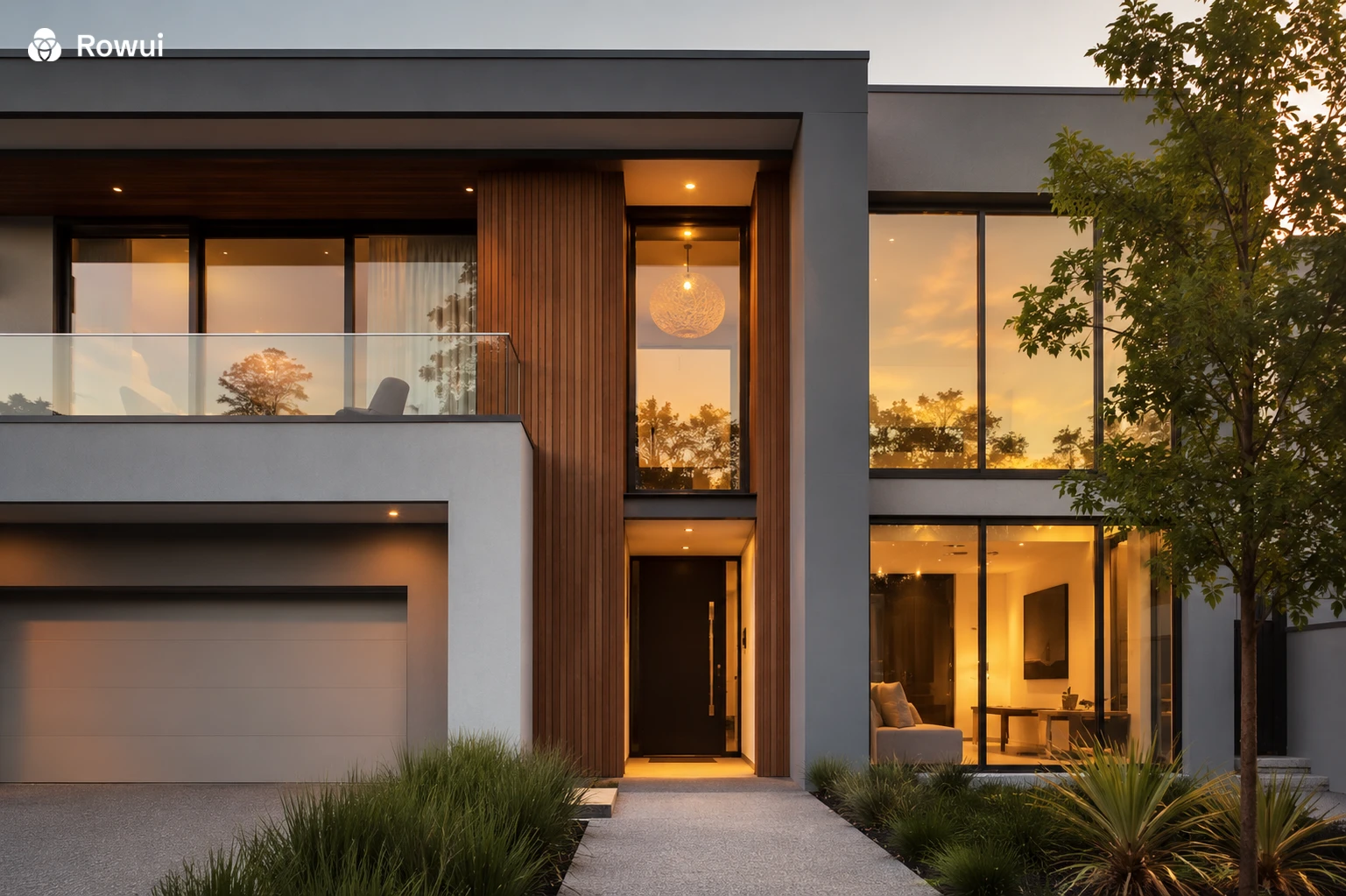
The key to successful material mixing is to ensure that each material has a clear architectural rationale for being where it is. A common and effective approach is to use a primary material for the main body of the house and a contrasting accent material to highlight a specific element such as the entrance, a projecting wing, or the upper storey. Brick as the primary material with a timber-clad porch volume at the entrance. Rendered walls with a zinc-clad bay window. White cladding with a charred timber ground floor plinth. In each case the junction between materials needs careful detailing to ensure it looks crisp and intentional rather than accidental.
Sustainability and Environmental Considerations
The environmental credentials of exterior cladding materials are becoming an increasingly important part of the selection process, and rightly so. The embodied carbon in building materials, the extent to which they can be recycled or reused at the end of their life, and their long-term maintenance requirements all contribute to the overall environmental footprint of a home over its lifetime.
Timber from certified sustainable sources has the lowest embodied carbon of any common cladding material and is the only option that is genuinely carbon negative in its production, since trees absorb carbon as they grow. Brick is energy-intensive to manufacture but has a very long service life and can be reclaimed and reused almost indefinitely. Zinc has a high embodied energy in its production but is fully recyclable and lasts for eighty to one hundred years in cladding applications. Render and fibre cement have relatively low embodied carbon but require periodic maintenance and eventual disposal that creates ongoing environmental impact.
Making Your Decision
With so many options available, narrowing down to the right exterior material for your specific home comes down to asking a small number of focused questions. What climate and weather conditions does the material need to perform in? How much ongoing maintenance are you genuinely prepared to commit to? What is the architectural character of the house, and which material or combination of materials reinforces rather than contradicts that character? What is the planning and neighbourhood context, and are there materials that would be out of place regardless of their individual merits? And finally, what is the realistic budget not just for purchase and installation but for maintenance over a twenty to thirty year horizon?
A common mistake is to assess materials purely on their upfront cost without accounting for whole-life cost. A rendered facade might cost less to install than brick but requires repainting every decade. A timber-clad facade might appear expensive initially but could require zero maintenance if the right species and detailing are chosen. Zinc is a significant upfront investment but carries essentially no maintenance cost and will outlast most other components of the building.
Conclusion
There is no single best exterior material for a modern house, because the right answer depends on the specific combination of your climate, your budget, your architectural vision, your maintenance tolerance, and the context of your site. What matters most is making the decision with genuine intention rather than defaulting to what is cheapest, most familiar, or most fashionable at the moment of construction.
The exterior of your home is its most permanent public statement. It is what your neighbours see every day, what visitors experience as they approach, and what you come home to after every trip away. Investing serious thought in that material choice, taking advice from an architect or designer who understands both the technical and the aesthetic dimensions, and choosing quality over false economy will pay back in satisfaction, in the value of your property, and in the simple daily pleasure of living in a home that looks exactly right.