When you are choosing a finish for the outside of your home, one of the most important questions you can ask is not just how it looks on day one, but how it will look in ten, twenty, or thirty years time. The exterior finish you choose will quietly shape the character of your home for decades, and the wrong choice can mean costly repairs, constant maintenance, and a facade that ends up looking tired and worn far sooner than you expected. Stone cladding, timber, and render are three of the most popular exterior finishes available to homeowners today, and each one ages in a completely different way. Understanding how and why they change over time will help you make a decision that suits your climate, your lifestyle, and the architectural style of your home.
Why Ageing Matters More Than First Impressions
It is easy to be swayed by a finish that looks stunning in a showroom or on a freshly completed build. But the true test of any exterior material is what happens after years of sun exposure, rain, frost, wind, humidity, and general weathering. A material that ages gracefully can actually become more beautiful over time, developing character and depth that a brand new surface simply cannot replicate. A material that ages poorly, on the other hand, can make a home look neglected even when it is being carefully maintained.
The way a finish ages also affects the running costs of your home. Some materials need recoating, resealing, or repainting every few years. Others are essentially self sufficient once installed. When you factor in the cost of labour and materials over a thirty year period, the initial price difference between options often becomes far less significant than the long term maintenance picture.
Stone Cladding: The Case for Timeless Durability
Stone is perhaps the oldest building material in human history, and for good reason. Natural stone cladding, whether it is sandstone, limestone, bluestone, granite, or slate, has a proven track record stretching back centuries. Many of the most admired buildings in the world are still standing, still beautiful, and still structurally sound after hundreds of years precisely because stone was used on their facades.
How Natural Stone Ages
Natural stone does not simply withstand the passage of time. It often improves with age. Sandstone develops a warm, honeyed patina that deepens in colour. Limestone weathers to a soft, almost chalky surface that softens sharp architectural lines beautifully. Granite remains essentially unchanged for generations, its mineral speckle as sharp and vivid as the day it was cut. Slate, used on facades or feature walls, takes on a subtle sheen over time as its surface is polished by rain and wind.
The key to stone cladding ageing well is the quality of the installation. Stone that is correctly pointed and sealed, with proper drainage details behind the cladding system, will perform reliably for the lifetime of the building. Stone that is poorly installed, particularly in climates with heavy frost, can suffer from spalling, where water penetrates the surface, freezes, and causes sections of stone to break away. In warmer, drier climates this is rarely an issue, and stone cladding is essentially maintenance free for decades at a time.
Manufactured Stone Veneer: A Different Ageing Story
Manufactured stone veneer, sometimes called reconstituted stone, is a concrete based product moulded to resemble natural stone. It is significantly lighter and less expensive than natural stone, and it can look convincing when freshly installed. However, its long term ageing story is quite different. Over ten to fifteen years, manufactured stone veneer can begin to show colour fading, particularly in panels that receive direct western or northern sun exposure. The pigments used to colour the concrete slowly bleach out, and the surface can develop a washed out, uniform appearance that lacks the depth of weathered natural stone.
Moisture management is also a more significant concern with manufactured veneer. If water finds its way behind the panels, the backing substrate can be damaged, and the veneer itself can crack or delaminate. Regular inspection of sealants around window reveals, corners, and base courses is important to keep the system performing as intended.
Which Stone Works Best in Different Climates
In coastal environments, granite and slate are excellent choices because they are highly resistant to salt air corrosion and moisture penetration. In inland areas with significant temperature swings between summer and winter, denser stones such as bluestone and granite again perform well. Softer stones like sandstone are best suited to drier climates where freeze thaw cycles are infrequent, as their more porous structure makes them marginally more vulnerable to frost damage over time.
Timber Cladding: Beautiful, Demanding, and Genuinely Alive
Timber cladding is unlike any other exterior material because it is a living product that continues to respond to its environment long after it has been cut, dried, and installed. This is both its greatest strength and its most significant challenge. Timber can produce a warmth and natural texture that no manufactured material has yet convincingly replicated, and a well maintained timber facade can look extraordinary for generations. But timber requires active, consistent care, and homeowners who underestimate this reality often end up with facades that deteriorate faster than expected.
How Timber Ages Naturally
Left completely untreated, most timber species will weather to a silvery grey colour within two to five years of installation. This is not damage. It is the natural oxidation of the timber surface and the breakdown of lignin, the compound that gives fresh timber its warm colour. Some homeowners actively choose this weathered silver look, which has a beautiful, almost Scandinavian quality when used on contemporary or coastal homes. Species like western red cedar, thermally modified ash, and Siberian larch all silver gracefully and maintain their structural integrity even as their surface colour shifts.
If you want to retain the original warm tone of your timber, regular oiling or staining is required. Clear oils typically need reapplication every one to two years in exposed locations. Pigmented stains last longer, often three to five years between coats, and provide better UV protection because the pigment absorbs some of the solar radiation that would otherwise break down the timber surface. The choice between accepting the silver and committing to ongoing maintenance is one of the most personal decisions a homeowner faces when choosing timber cladding.
Species Selection and Its Long Term Impact
Not all timber is equal in terms of durability and ageing performance. Hardwood species such as spotted gum, blackbutt, and ironbark are naturally dense and highly resistant to moisture, insects, and decay. They are among the most durable cladding timbers available and can last for many decades with relatively modest maintenance. Softwoods such as pine require more thorough treatment and more frequent maintenance to achieve comparable longevity.
Thermally modified timber, which has been heat treated to alter its cellular structure and dramatically reduce its moisture absorption, has become increasingly popular for exterior cladding. Species like thermally modified pine and ash perform like natural hardwoods without the cost, and they are dimensionally stable in a way that untreated softwoods are not. This stability means less cracking, less cupping, and a more consistent surface appearance over time.
Timber and Moisture: The Critical Relationship
The single most important factor in how well timber cladding ages is how effectively moisture is managed. Timber that is regularly wetted and then allowed to dry fully will perform well. Timber that stays wet for extended periods, particularly at joints, end grain, and behind flashings, is at serious risk of rot, staining, and premature failure. Good detailing at the design stage, including generous eave overhangs, proper flashing at all horizontal junctions, and adequate ventilation behind the cladding, makes an enormous difference to long term performance. The difference between a timber facade that lasts fifty years and one that starts to fail after fifteen is usually in these details, not in the species or the finish.
Render: Versatile, Stylish, and Dependent on the Right System
Rendered facades have been a staple of residential architecture for centuries, and their popularity shows no sign of fading. The clean, smooth surface of a freshly rendered wall has an effortless elegance that suits everything from Californian bungalows to contemporary flat roof homes. But render is perhaps the most system dependent of the three finishes discussed here, meaning its long term performance is heavily influenced by what lies beneath it and how carefully it was applied.
Traditional Cement Render Versus Acrylic Systems
Traditional cement based render has been used for generations and is still a reliable option when correctly specified and applied. It is breathable, meaning it allows moisture to pass through the wall without being trapped, and it bonds well to brick, block, and concrete substrates. Over time, cement render can develop fine hairline cracks, particularly at structural junctions and around openings where differential movement occurs. These cracks are generally cosmetic in nature but need to be addressed promptly, because left unsealed they allow water to penetrate and undermine the bond between the render and the substrate.
Acrylic render systems, including the polymer modified renders that have become standard in contemporary residential construction, offer greater flexibility and crack resistance than traditional cement render. They are also available in a very wide range of textures and can be factory tinted so that the colour is integral to the render itself rather than applied as a paint coat over the top. This means that light surface abrasion does not immediately expose a different coloured layer beneath, which is a significant advantage in terms of long term appearance.
How Render Weathers Over Time
The most common ageing issues with rendered facades are cracking, staining, and colour fading. Cracking, as noted above, tends to occur at structural joints and around openings. Staining is particularly common on smooth render finishes in humid or coastal climates, where algae, moss, and airborne grime adhere easily to the flat surface. A textured render finish hides minor staining more effectively than a smooth one, though it is also harder to clean when a full wash is required.
Colour fading is a gradual process that affects all painted and tinted render finishes to some degree. Darker colours tend to fade more visibly than lighter ones, and south and west facing walls receive the most UV radiation and therefore show the fastest colour change. Choosing a high quality acrylic paint or an integrally tinted render system with good UV resistance will slow this process considerably. Most render facades in reasonable condition need repainting every eight to twelve years, which is a predictable and manageable maintenance cycle for most homeowners.
The EIFS and Insulated Panel Question
External insulation and finish systems, commonly known as EIFS or polystyrene cladding systems, have grown in popularity because they add significant thermal insulation to the wall assembly while also providing a rendered appearance. When correctly installed with proper drainage details and durable coatings, these systems can perform well. However, there have been significant issues across the industry with water ingress behind poorly detailed EIFS systems, and the remediation costs when moisture damage occurs behind these systems can be very substantial. If you are considering an EIFS system, engaging a specialist with strong references and ensuring robust detailing at all junctions is absolutely essential.
Comparing Long Term Ageing Side by Side
If you lay the three materials side by side and assess how they typically look after ten, twenty, and thirty years, a clear picture emerges. Natural stone cladding, correctly installed, tends to look better at thirty years than it did at ten, because the weathering process adds depth and character to the surface. Timber cladding at thirty years either looks beautifully weathered and full of character, if it has been well maintained or has been allowed to silver gracefully, or it looks tired and potentially damaged if maintenance has been inconsistent. Render at thirty years has almost certainly been repainted at least twice, and its appearance at that point depends heavily on the quality of those repainting cycles.
In terms of maintenance cost over a thirty year period, natural stone typically requires the least intervention after the initial installation. Timber requires the most active maintenance but rewards that investment with an aesthetic that many homeowners consider unmatched. Render sits comfortably in between, with predictable repainting cycles and generally manageable crack repairs as the primary ongoing costs.
Combining Materials for Maximum Impact and Longevity
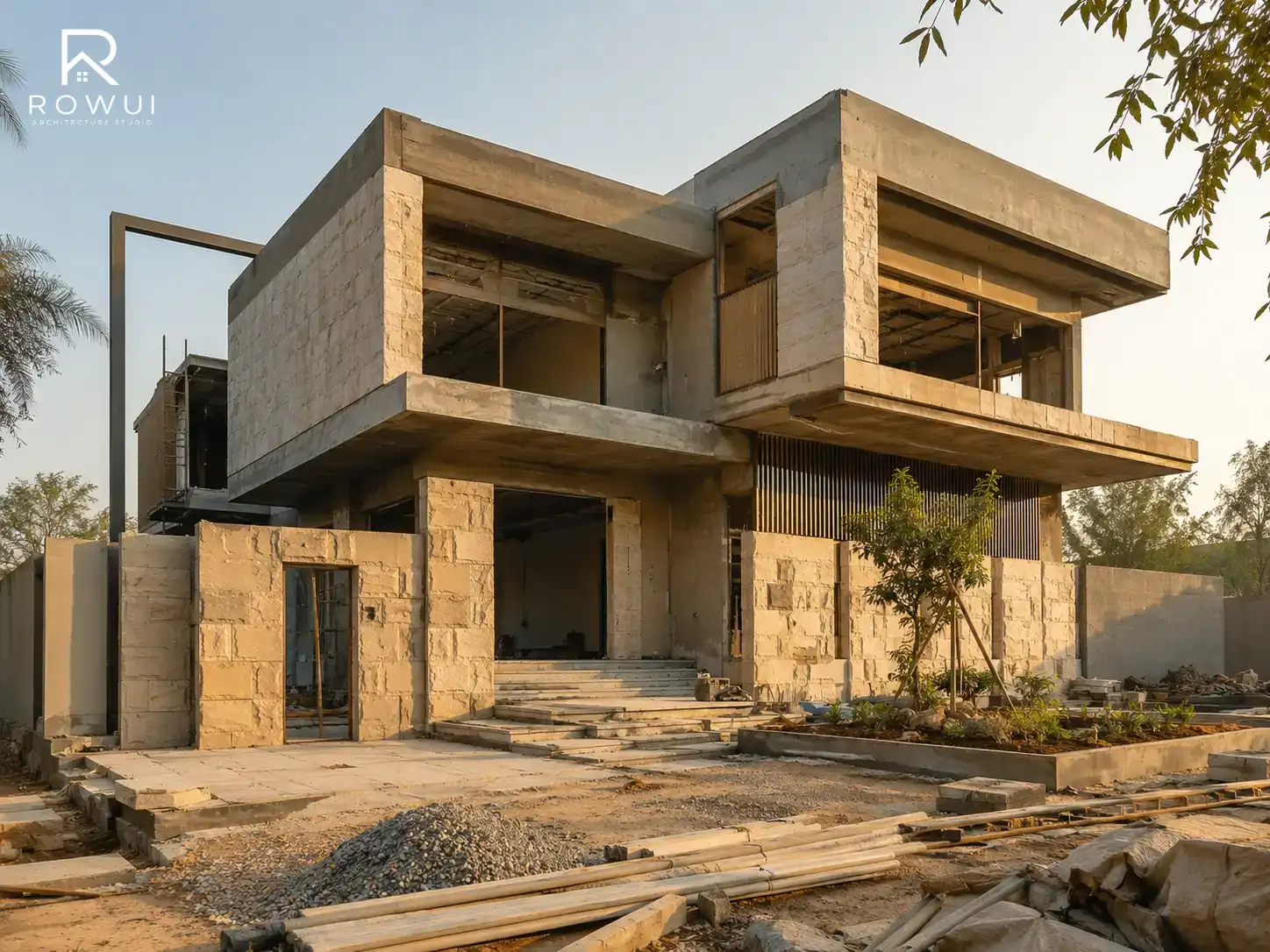
One of the most effective strategies for both aesthetic impact and long term durability is to combine two of these materials on a single facade. A lower section of stone cladding paired with render above is a classic combination that works beautifully because it provides the natural texture and durability of stone at the most exposed level of the facade while keeping the upper walls clean and light. Stone at the base of a building also helps to conceal the splash zone staining that affects render and timber in areas of high rainfall.
Timber combined with render is another highly successful pairing, particularly on contemporary homes. A rendered main body with a feature blade wall or entrance canopy clad in natural timber creates a warm and sophisticated contrast. The timber element is often sheltered under an eave or recessed slightly from the main facade plane, which reduces its weather exposure and therefore its maintenance requirements considerably.
Climate, Orientation, and Local Conditions
No material discussion is complete without acknowledging that climate plays an enormous role in how any exterior finish performs and ages. A beautifully chosen timber facade that thrives in the dry warmth of inland Australia may struggle in the constant dampness of a high rainfall coastal environment. A rendered facade that looks pristine in a temperate inland climate may develop persistent algae staining within a few years if installed in a humid subtropical location.
Before committing to any exterior finish, it is worth speaking with local builders and architects who have direct experience of how that material performs in your specific climate and location. Look at older homes in your area that have used the finish you are considering and observe how they have aged. This kind of real world observation is more valuable than any brochure, and it will give you a genuinely reliable picture of what to expect over the long term.
Practical Tips for Getting the Best Out of Any Material
Regardless of which material you choose, there are several universal principles that will significantly improve its long term performance. First, invest in proper drainage and flashing details at every junction, particularly around windows, doors, roof lines, and where the cladding meets the ground or a horizontal surface. Water that finds a way behind an exterior finish is the primary cause of premature failure across all three material types.
Second, choose the right products for your climate and substrate. A render system specified for a brick veneer home in a temperate climate is not necessarily appropriate for a steel framed home in a high humidity coastal environment. The specification matters as much as the material itself.
Third, establish a maintenance schedule and commit to it. Even natural stone benefits from an inspection every five years to check pointing and sealants. Timber needs its oil or stain refreshed on a regular cycle. Render needs its cracks attended to before they become water entry points. The homes that age most gracefully are not necessarily the ones with the most expensive finishes. They are the ones whose owners take a little time each year to keep them in good condition.
Conclusion
Stone cladding, timber, and render each have a genuinely compelling case for long term use on residential facades, but they age in fundamentally different ways and suit different lifestyles, climates, and architectural visions. Natural stone is the closest thing to a set and forget material, improving with age and requiring minimal intervention when properly installed. Timber is the most expressive and emotionally resonant choice, but it asks for your ongoing attention and rewards you generously when it receives it. Render is the most versatile option in terms of colour and texture, and its maintenance cycle is predictable and manageable for most homeowners.
The best choice is not the one that ages most perfectly in isolation. It is the one that ages best in the context of your home, your climate, your maintenance capacity, and the character you want your home to project over the decades ahead. Choose with your eyes wide open to the long game, and your home will reward you with a facade that looks and performs beautifully for generations.