There is a particular kind of disappointment that comes with finishing a modern interior and realising it feels cold. The clean lines are there, the neutral palette is in place, the furniture is sleek and considered, and yet something essential is missing. The room looks like a photograph but does not feel like a home. This is one of the most common struggles homeowners face when working with contemporary design, and it has less to do with budget than with understanding how warmth is actually created in a space. Luxury and warmth are not opposites of modernity. They are simply layers that most modern interiors forget to add.
Understanding Why Modern Interiors Can Feel Cold
Modern design principles prioritise simplicity, order and visual calm. These are genuinely valuable qualities. But when taken too far, or applied without balancing elements, they strip a space of the sensory richness that makes people feel comfortable and at ease. Hard surfaces, minimal colour, uniform lighting and the absence of natural materials all contribute to that clinical feeling that gives minimalism a bad reputation among people who actually live in their homes full time.
The good news is that warmth is not a style. It is a quality, and it can be layered into any aesthetic without compromising the modern character of the space. Understanding which elements create warmth, and why, gives you precise tools to work with rather than vague instructions to simply add cushions or plants.
Start With the Palette: Warm Neutrals Over Cool Ones
Colour temperature is the foundation of how warm or cold a space feels before a single piece of furniture is placed. Many modern interiors default to cool greys, stark whites and blue-toned stone, all of which push a room toward feeling institutional rather than intimate. The shift toward warmth begins with choosing neutrals that have a warm undertone baked into them.
Choosing the Right Whites and Greys
Pure white walls reflect light in a way that feels clean but detached. Replacing stark white with tones like warm linen, aged parchment, soft ochre white or creamy off-white immediately changes the emotional temperature of a room. Farrow and Ball's String, Joa's White or Dead Salmon are examples of whites and near-neutrals that carry warmth without reading as beige in the traditional sense. In grey families, leaning toward greige, warm taupe or mushroom rather than blue-based cool greys creates a palette that still reads as sophisticated and contemporary but feels significantly more inviting.
Introducing Earthy Tones as Accents
Terracotta, rust, amber, warm sage, deep olive and dusty rose are all accent colours that bring organic warmth into a modern context without feeling traditional or rustic. These tones work particularly well as a single wall colour in a living room or bedroom, as upholstery on a feature chair or sofa, or through soft furnishings like cushions and throws. The key is restraint. One or two earthy tones introduced thoughtfully carry far more visual warmth than many colours competing for attention.
Material Selection: The Real Difference Between Cold and Warm
Materials are arguably the single most important factor in whether a modern interior feels warm or cold. Glass, polished concrete, chrome and high-gloss lacquer are all materials associated with contemporary design, but they are also materials that reflect light and resist tactile engagement. Warmth comes from materials that absorb, diffuse and invite touch.
Timber as a Structural Warmth Provider
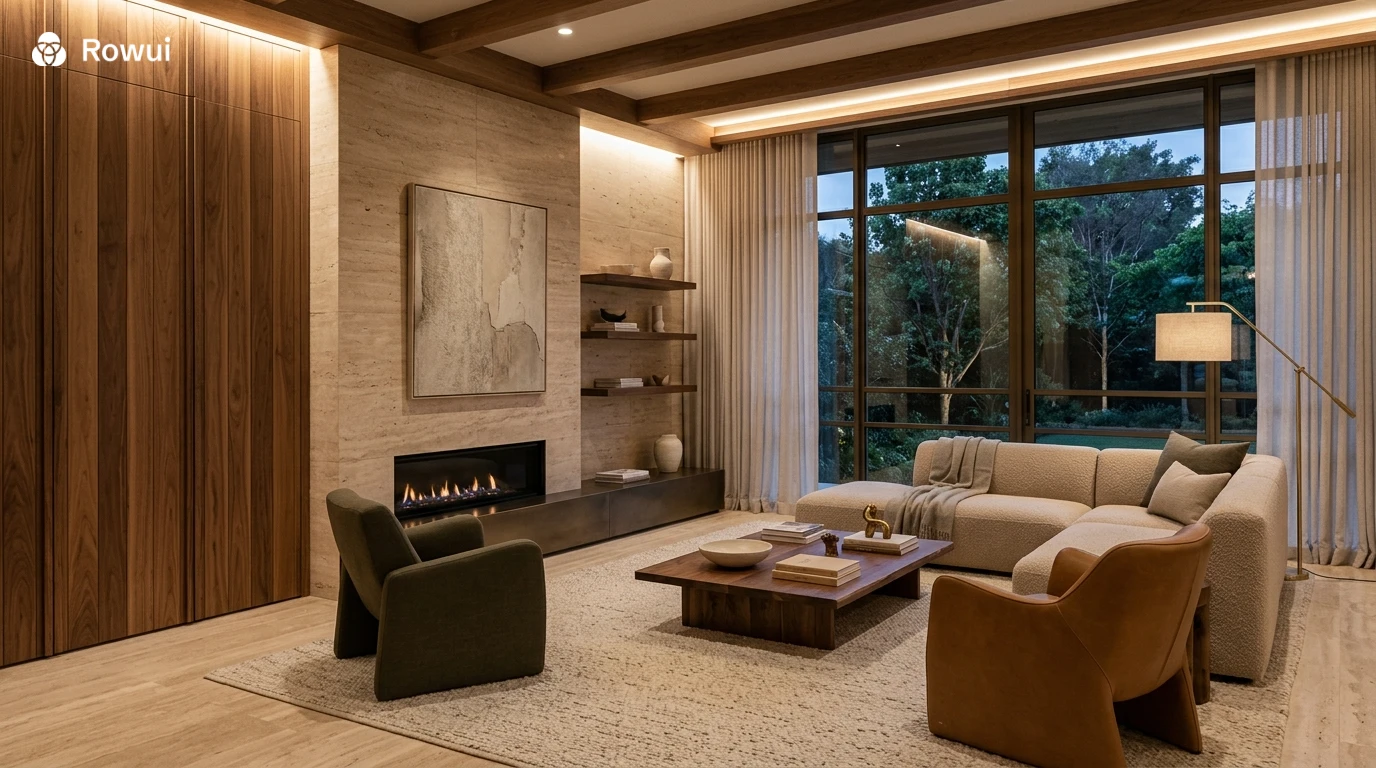
Timber is the most powerful warming material available to an interior designer. It does not need to appear in rustic or traditional forms to be effective. A continuous oak floor with a natural or matte finish, walnut cabinetry in a modern kitchen, exposed timber ceiling beams in an otherwise minimal living room, or a simple timber staircase with clean lines all introduce warmth at a structural level, meaning the room feels warm before any decorative decisions are made. The grain of timber gives the eye something organic to rest on, which is psychologically reassuring in a way that polished stone or lacquer simply cannot replicate.
Medium and darker timber tones, such as American walnut, smoked oak, teak and blackened oak, work exceptionally well in contemporary settings because they are rich in colour without reading as traditional. Lighter timbers like ash or blonde oak work well in Scandinavian-influenced spaces where the warmth comes more from texture and material honesty than from depth of colour.
Stone With Character
Not all stone is cold. The mistake many homeowners make is choosing highly polished, vein-free stone in cool white or grey, which does indeed read as clinical. Choosing stone with visible veining, fossils, tonal variation or a honed rather than polished finish changes everything. Warm limestones, travertine, sandy sandstones and even terrazzo with warm aggregate all bring a geological richness that connects a space to something ancient and natural. Travertine in particular has had a strong return to contemporary interiors because its open pore texture and warm cream to caramel tones provide the perfect counterbalance to modern architecture's precision.
Plaster, Limewash and Textured Walls
The wall finish in a modern interior is often overlooked as a warmth-generating surface. Standard emulsion paint on flat plasterboard is convenient but visually inert. Introducing Venetian plaster, limewash paint, tadelakt or textured render immediately adds depth and movement to a wall. These finishes catch light differently throughout the day, creating a surface that feels alive rather than static. Limewash walls in warm ochre, terracotta or deep clay tones have become one of the most effective single design decisions a homeowner can make to shift a modern interior from cold to warm and considered.
Lighting: The Architecture of Atmosphere
Lighting is where most modern interiors fail spectacularly. A grid of recessed downlights in the ceiling is efficient and even, and it is also completely devoid of atmosphere. Luxury hotels, high-end restaurants and beautifully designed homes all share one lighting principle: light comes from multiple sources at different heights, with warm colour temperatures, and it creates pools of light rather than flooding a space uniformly.
Layering Your Light Sources
A well-lit modern interior uses at least three layers of lighting. Ambient light provides general illumination but should not dominate. Task lighting addresses functional needs like reading or cooking. Accent lighting highlights architecture, art or objects and creates the warm pools of light that give a room its atmosphere. Adding floor lamps with warm shades, wall sconces that wash a textured wall with gentle light, pendant lights over a dining table at a human height, and small table lamps on side tables collectively transforms how a room feels after dark.
Colour Temperature Is Non-Negotiable
The colour temperature of your bulbs matters enormously. Cool white light at 4000K or above is appropriate in bathrooms and kitchens but creates a harsh, unwelcoming atmosphere in living rooms and bedrooms. Warm white at 2700K to 3000K is the range that produces the golden, comfortable glow associated with candlelight and luxury hospitality. If your home currently feels cold in the evenings despite good furniture and materials, switching to warm white bulbs is often the fastest and most affordable improvement available to you.
Firelight and Candlelight
Nothing replicates the warmth of actual flame. A fireplace, whether wood burning, gas or ethanol, is one of the most transformative additions to a modern living room not just because of the heat it provides but because of the flickering, organic light it generates. Even a wall-mounted ethanol burner or a simple arrangement of pillar candles on a hearth shelf provides a quality of warmth that no electric light source can achieve. Candlelight on a dining table at the right height creates a sense of intimacy and luxury that costs almost nothing and works in any interior style.
Furniture: Softness, Scale and the Right Upholstery
Modern furniture design often prioritises visual lightness and structural elegance over comfort and generosity. Furniture that looks beautiful but does not invite you to sit deeply, stretch out or stay awhile fails the most basic test of residential design. Warmth in furniture comes from scale, material and the presence of softness.
Generous, Low-Profile Seating
A sofa that is deep enough to curl up in, upholstered in a natural fabric like linen, boucle, velvet or wool, immediately communicates comfort and luxury. Boucle in particular has become synonymous with warm contemporary interiors because its looped, textural weave is visually soft and physically inviting while remaining entirely modern in character. Avoid furniture with thin cushions, tight weaves or hard edges in living spaces intended for relaxation. The human body knows instantly whether a chair wants to hold it.
Natural Fibres and Layered Textiles
A room with no soft furnishings echoes. A room with layered textiles absorbs sound, diffuses light and creates the kind of sensory richness associated with well-appointed spaces. Wool rugs, linen curtains that pool slightly at the floor, cashmere or chunky-knit throws draped with intention over a sofa arm, and a mix of cushion sizes and textures on a bed or seating area all contribute to warmth without adding visual clutter if the palette is kept cohesive. Natural fibres are essential here. Synthetic versions of the same shapes look similar at a distance but lack the depth and richness of real wool, linen, cotton or silk.
Bringing Nature Inside: Plants, Wood and Organic Form
Human beings are biophilic by nature, meaning they have an instinctive positive response to natural forms, organic shapes and living things. Modern interiors that feel cold are almost always environments that have removed nature entirely in favour of geometric precision. Reintroducing organic form is one of the most reliable ways to make a space feel alive and welcoming.
Large Format Plants as Architectural Elements
A single large fiddle leaf fig, olive tree, monstera or bird of paradise plant placed deliberately in a corner, beside a staircase or near a window does more for the warmth and vitality of a room than most decorative purchases. These plants have strong architectural form that complements modern interiors while introducing scale, colour and the quiet energy of living things. Smaller plants grouped together on a shelf or windowsill create a similar effect in a more compact way. Terracotta pots, rattan baskets and stone planters all enhance the organic quality of the arrangement.
Sculptural Objects and Handmade Pieces
Mass-produced decorative objects tend to look exactly like what they are: efficient but impersonal. Handmade ceramics, hand-thrown pottery, woven baskets, carved wooden bowls and artisan glass objects carry evidence of human making that adds irreplaceable warmth to a modern interior. These pieces do not need to be expensive. A handmade ceramic vase from a local maker, a woven wall piece, or a piece of driftwood shaped into an unexpected form placed on a shelf communicates something about the person who lives there in a way that perfectly matched sets of objects cannot.
Ceilings, Joinery and Architectural Detail
Warmth in a luxury interior often lives in the details that are easy to overlook during the planning phase but impossible to ignore once the space is complete. Architectural details are what separate a designed space from a merely decorated one.
Ceiling Details That Change the Character of a Room
A flat white ceiling with recessed lights is the architectural equivalent of a blank stare. Introducing a timber-clad ceiling panel, exposed beams, a deeply moulded cornice in a more traditional modern style, or even a subtle coffered ceiling grid gives the room a sense of considered design overhead. Painting the ceiling in a tone slightly deeper than the walls, or introducing a matte black ceiling in a room with brass and warm timber accents, creates an enveloping, cocooning effect that is immediately associated with high-end hospitality design.
Joinery That Goes to Ceiling Height
Built-in joinery that runs from floor to ceiling has a disproportionate effect on the perceived quality of an interior. Full-height cabinetry, bookshelves, wardrobes and wall panelling all eliminate the visual gap between furniture and ceiling that makes rooms feel incomplete. When this joinery is executed in warm timber veneer, painted in a sophisticated dark tone like deep forest green or midnight navy, or detailed with fluted panels and integrated lighting, it becomes a piece of architecture rather than storage. This is the difference between a room that looks expensive and one that looks assembled.
The Role of Art and Personal Story
A modern interior without art is a showroom. Art is not decoration in the superficial sense. It is evidence of a life, a point of view and a set of sensibilities. Large scale artworks, whether paintings, prints, photographs or textiles, give the eye a focal point and tell the viewer something about who lives in the space. A single oversized canvas in a living room, hung at the correct height with proper lighting above it, commands a room with a confidence that no arrangement of smaller frames can match. The frame matters too. A wide, warm timber or plaster frame on a piece of artwork ties it to the materiality of the room and makes it feel like a considered choice rather than an afterthought.
Scent, Sound and the Invisible Dimensions of Warmth
Warmth in an interior is not purely visual. The most sophisticated spaces engage the senses beyond sight, and this is something that architecture magazines rarely discuss but every person immediately notices when they walk into a beautiful home. The smell of a space communicates something before the eye has finished processing the room. A diffuser with a warm, woody or floral scent, a beeswax candle burning in the kitchen, or the natural smell of real timber and linen all contribute to the sense of warmth and luxury in ways that are subconscious but powerful.
Acoustics work similarly. Hard surfaces in a modern interior create reverberation that makes a space feel cold and unwelcoming. Soft furnishings, rugs, curtains and upholstered walls absorb sound and create the quieter, more intimate acoustic environment associated with comfort and luxury. If a room echoes noticeably when you speak, it needs more soft material to feel truly warm.
Conclusion
Making a modern interior feel warm and luxurious is not about abandoning contemporary design principles or loading a space with ornament and clutter. It is about understanding the specific qualities that create warmth, which are material richness, layered lighting, organic form, human scale, tactile softness and personal expression, and then applying them with the same discipline and intention that defines good modern design. Start with the palette and push it toward warmth. Choose materials that invite touch and have natural variation. Layer your lighting so that the room works as well at nine in the evening as it does at midday. Invest in furniture that actually wants to be sat in. Bring in timber, stone, plants and handmade objects that connect the space to something beyond the catalogue. Add architectural detail that makes the room feel finished rather than assembled. Do these things thoughtfully and consistently and the result will be a modern interior that is not just visually impressive but genuinely beautiful to live inside.