
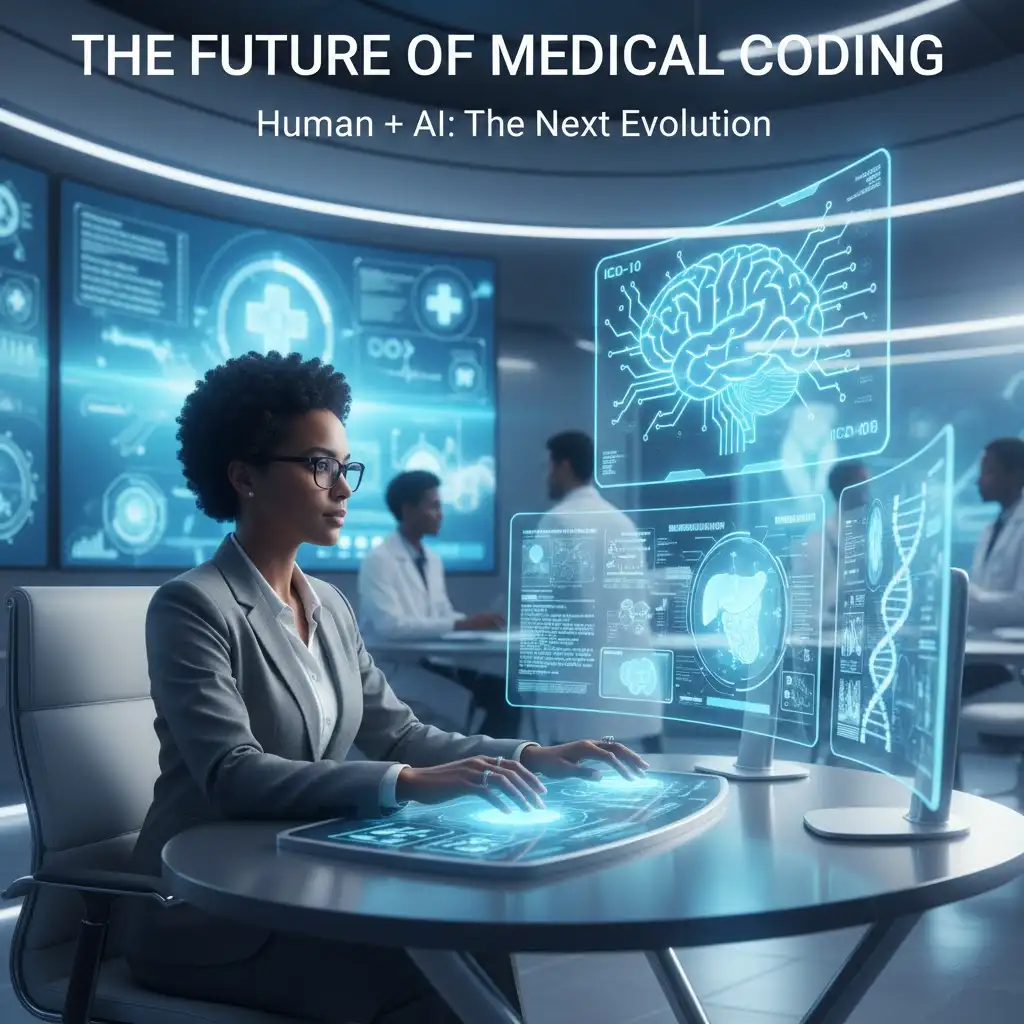
The question of whether medical coding will be replaced by artificial intelligence has become one of the most common concerns in healthcare. As we move through 2026, the answer is clearer than ever. AI will not replace medical coders, but it is fundamentally reshaping what the role looks like.
Medical coding is shifting away from pure data entry and toward a human guided model. While AI systems can process thousands of patient charts in seconds, they still lack clinical judgment, ethical reasoning, and the ability to handle ambiguity. These human skills remain critical in healthcare environments where accuracy directly affects patient care, compliance, and revenue.
How AI Is Changing Medical Coding in 2026
AI is no longer experimental in healthcare. It is now embedded into everyday revenue cycle operations and works as a constant assistant for coding teams.
Autonomous Coding for High Volume Cases
By 2026, autonomous coding is widely used in high volume and highly standardized specialties such as radiology, pathology, and emergency medicine. These systems use natural language processing to read physician notes and automatically assign ICD and CPT codes.
AI can process a single encounter in seconds and often achieves high first pass accuracy in routine cases. This has significantly reduced turnaround time and clerical workload for human coders.
Real Time Documentation Support
AI tools are now built directly into electronic health record systems. As physicians document care, AI suggests appropriate codes and highlights missing details, such as incomplete diagnoses or unsupported procedures.
This real time assistance reduces follow up queries between coders and providers and improves documentation quality before claims are submitted.
Predictive Denial Prevention
Modern AI does more than assign codes. It analyzes historical payer data to predict which claims are likely to be denied. Coders can correct potential issues before submission, improving clean claim rates and reducing payment delays.
Why Human Coders Are Still Essential
Despite rapid automation, there are gaps that AI cannot close. These gaps are where human expertise becomes even more valuable.
Clinical Nuance and Context
Medical documentation is rarely clean or consistent. Physicians may document symptoms, exclusions, and observations that appear contradictory without proper context. Humans are better at understanding the full clinical picture and selecting codes that reflect true patient conditions.
Complex and High Risk Cases
AI performs well with straightforward encounters but struggles with complex surgeries, oncology cases, neurological conditions, and multi system diseases. These scenarios require deep anatomical knowledge and an understanding of clinical intent that current AI systems cannot fully replicate.
Compliance and Ethical Responsibility
Medical coding carries legal responsibility. When audits occur, someone must explain why a specific code was chosen. AI cannot defend its logic or provide ethical judgment. Human coders remain responsible for compliance, audit defense, and regulatory interpretation.
The Role Shift From Coder to AI Supervisor
The most successful professionals in 2026 are those who manage AI rather than compete with it. Medical coding roles are evolving into hybrid positions that combine clinical knowledge with technology oversight.
Coders now review AI generated codes, validate confidence levels, and correct machine errors. Others work closely with physicians to improve documentation quality so AI systems perform better. Some analyze AI generated reports to identify denial patterns and revenue opportunities.
Is Medical Coding Becoming Obsolete?
Medical coding is not a dying career. Demand continues to grow due to aging populations, chronic disease complexity, and regulatory requirements. What is disappearing is the role focused solely on manual code entry.
Coders who add value through auditing, compliance, analytics, and clinical collaboration are becoming more valuable, not less.
Skills That Matter in the AI Era
To remain relevant, medical coders must expand beyond memorization of code sets.
Understanding how AI and language models function helps coders spot errors and limitations. Data literacy allows professionals to interpret reports and improve financial outcomes. Familiarity with ICD eleven provides a strong advantage as healthcare systems modernize. Communication skills are essential when working with physicians, auditors, and technology teams.
The Future of Medical Coding
Medical coding is not being eliminated. It is being elevated. AI is removing repetitive tasks and allowing professionals to focus on accuracy, strategy, and compliance.
The future belongs to coders who understand both medicine and technology. Those who learn to supervise AI, question its output, and guide its use will remain essential to healthcare operations.
Medical coding is not ending. It is evolving into a smarter, more strategic profession.