
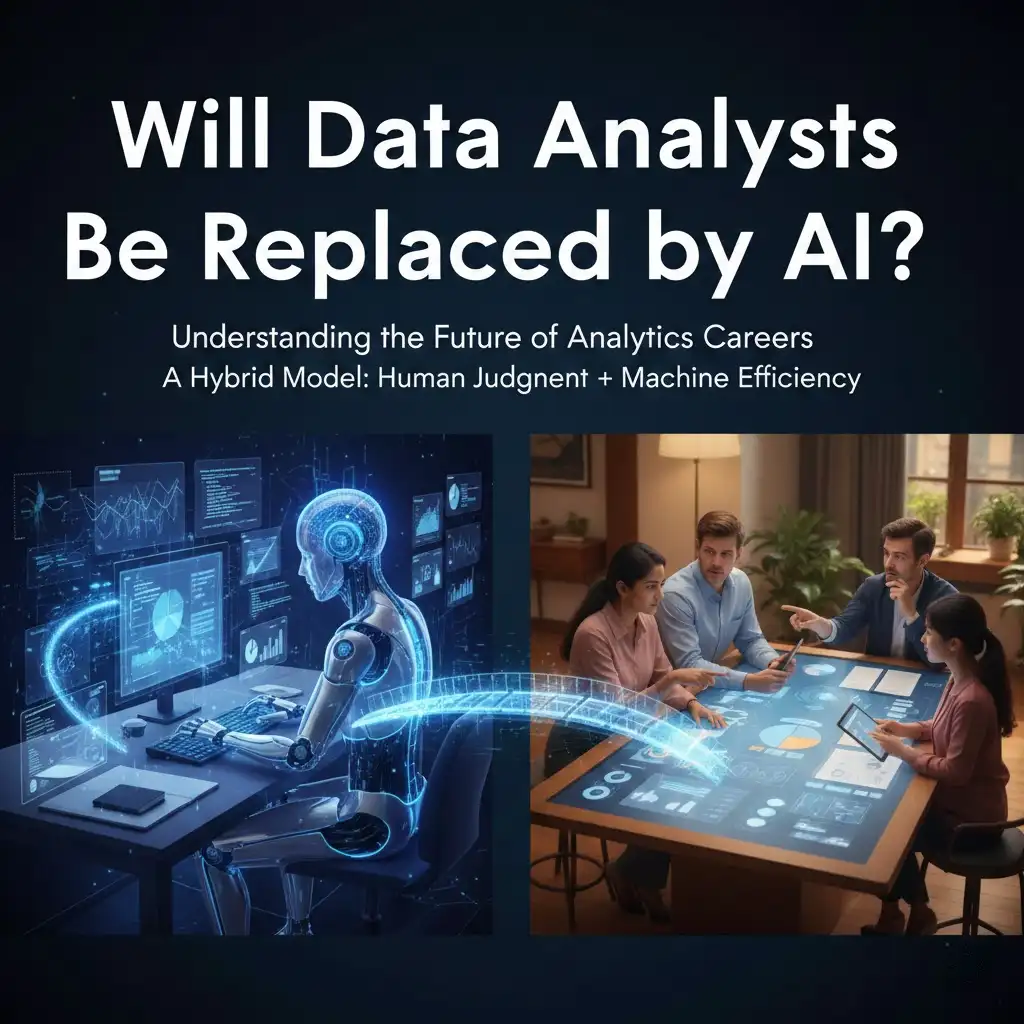
Artificial Intelligence is transforming industries faster than many of us can keep up with. From healthcare and finance to marketing and logistics, AI is reshaping how work gets done. One question comes up again and again: Will data analysts be replaced by AI?
The short answer is no. But the truth is more nuanced. AI is not eliminating the need for human analysts. Instead, it is changing how they work, creating opportunities for higher-level thinking and strategic contributions.
In this blog, we’ll explore the evolving role of data analysts, the skills that will remain essential, and how AI is creating a hybrid model that blends human judgment with machine efficiency. We’ll also cover career implications, salary trends, and how aspiring analysts can future-proof their careers.
The Current Role of Data Analysts
Data analysts sit at the intersection of raw information and actionable insight. Their work typically involves:
- Cleaning and preparing data: removing errors, handling missing values, and transforming data into usable formats.
- Exploratory analysis: identifying patterns, trends, and anomalies in datasets.
- Reporting: creating dashboards, visualizations, and summaries for stakeholders.
- Basic predictive modeling: using statistical techniques to forecast trends or outcomes.
Much of this work is critical but repetitive and rules-based. That’s exactly the type of task AI excels at automating.
How AI is Changing the Role of Data Analysts
AI technologies, including machine learning, generative AI, and AutoML platforms, are making routine data tasks faster, more accurate, and less labor-intensive. Here’s how:
Automation of Repetitive Tasks
AI can now clean and preprocess data automatically, detect anomalies in large datasets, generate routine reports and dashboards, and perform basic forecasting. Tools like Microsoft Power BI’s AI features, Tableau’s “Explain Data” functionality, or AutoML platforms can take raw datasets and produce meaningful insights with minimal human input.
The impact is clear: analysts who primarily perform manual, repetitive tasks may see a reduction in demand for these skills.
Increased Efficiency Through AI
Generative AI tools can assist analysts in writing SQL queries, Python scripts, or R code. AutoML platforms can automatically select the best machine learning models, tune hyperparameters, and even evaluate performance.
Analysts can accomplish more in less time. Instead of spending hours coding, they can focus on interpreting results and making strategic recommendations.
The Rise of New Roles
AI is not eliminating jobs. It is transforming them. Analysts are increasingly becoming:
- AI orchestrators: managing and supervising AI agents to ensure the right models are applied to the right problems.
- Data storytellers: translating complex datasets into actionable business narratives.
This evolution emphasizes human skills that machines cannot replicate: context, judgment, and creativity.
Skills That Remain Essential (and Are Amplified by AI)
While AI automates technical tasks, several human-centric skills become even more valuable:
Critical Thinking and Contextual Understanding
AI can spot patterns, but it cannot always explain why they exist. Analysts must interpret results in the context of business objectives, market conditions, and human behavior.
For example, AI may flag a sudden dip in sales. A human analyst might connect that trend to a marketing campaign, competitor activity, or seasonal factors insights AI alone cannot reliably provide.
Business Acumen
Connecting data insights to business strategy is irreplaceable. Analysts must understand company goals, industry dynamics, and operational constraints to turn data into actionable decisions.
Communication Skills
Even the most accurate AI-generated insights are useless if stakeholders don’t understand them. Analysts must explain findings clearly, persuade decision-makers to act, and design compelling dashboards and visualizations.
Creativity and Strategic Thinking
Human analysts ask questions AI cannot. They design experiments, hypothesize about trends, and guide AI to explore meaningful avenues.
Ethical Judgment
AI can be biased or generate misleading results. Analysts must ensure responsible use, prevent ethical violations, and validate AI outputs before making decisions.
The Hybrid Future: Humans and AI
The future of data analytics is not AI versus humans. It’s AI with humans.
A typical workflow might look like this:
- Data ingestion: AI cleans and structures incoming datasets automatically.
- Analysis: AI detects trends and anomalies, runs basic forecasts, and generates preliminary reports.
- Interpretation: Human analysts validate AI outputs, provide context, and connect insights to strategic objectives.
- Storytelling: Analysts craft dashboards, presentations, or narratives for decision-makers.
- Action: Stakeholders make data-informed decisions guided by both AI insights and human judgment.
This hybrid model leverages the strengths of both AI and human intelligence. Humans bring strategy, ethics, context, and creativity. AI brings scale, speed, and consistency.
Career Implications for Data Analysts
AI adoption does not mean unemployment. It means evolution. Analysts need to:
Upskill
Learn to use AI-powered analytics tools. Skills such as generative AI for coding, AutoML platforms for predictive modeling, and advanced visualization tools with AI integration will become increasingly valuable. Analysts who integrate AI into their workflow will be more productive and strategic.
Focus on Human-Centric Skills
Communication, storytelling, ethical decision-making, and domain expertise cannot be automated. Analysts who excel in these areas will thrive.
Diversify Roles
AI introduces new roles like AI analyst or orchestrator, data storyteller, and AI ethics specialist. These positions focus on managing AI workflows, translating insights, and ensuring responsible AI use.
Addressing Common Questions
Will AI replace data analysts? No. AI will automate repetitive tasks but not replace human judgment, strategic thinking, or ethical decision-making. Analysts who adapt will thrive, while those who resist may struggle.
Will AI replace data scientists? AI can assist with model building and preprocessing, but data scientists bring problem framing, experimentation, and algorithm design. These human elements remain irreplaceable.
Will ChatGPT replace data analysts? Tools like ChatGPT can generate SQL queries, code snippets, and insights summaries, but they cannot interpret results in context or communicate actionable recommendations.
Will AI affect salaries? AI adoption may shift salaries toward higher-value, AI-enhanced roles. Analysts who leverage AI effectively could see growth, while those stuck in repetitive tasks may face stagnation.
Preparing for the AI-Enhanced Analytics Landscape
To thrive in a world of AI-enhanced analytics:
- Learn AI tools, including AutoML, Python AI libraries, and generative AI for coding.
- Strengthen business knowledge and understand trends, KPIs, and decision-making frameworks.
- Focus on storytelling with dashboards, reports, and persuasive communication.
- Practice ethical decision-making, considering AI bias, data privacy, and responsible analytics.
- Embrace lifelong learning to stay ahead of AI trends.
Case Studies: How AI Transforms Data Analyst Work
Marketing analysts can spend hours cleaning campaign data. With AI, data cleaning and basic reporting are automated, allowing them to focus on audience segmentation, campaign performance, and strategy.
In finance, AI detects anomalies in transaction data. Analysts investigate, applying judgment to guide decisions. Fraud detection becomes faster and more reliable.
In healthcare, AI analyzes patient data for trends and treatment efficacy. Human analysts interpret these trends, considering ethical, medical, and regulatory factors to influence patient care strategies.
The Bottom Line
AI is not replacing data analysts. It is transforming them. The future is hybrid intelligence, where machines handle scale, speed, and repetitive tasks, and humans provide judgment, strategy, creativity, and ethical oversight.
Analysts who embrace AI tools, continuously upskill, and focus on human-centric strengths will thrive. Those who ignore the shift may find themselves at risk. The message is clear: AI is a partner, not a replacement. The data analyst of the future is part strategist, part storyteller, and part AI orchestrator.
Key Takeaways
- AI automates repetitive tasks but cannot replace human judgment.
- Analysts will evolve into roles emphasizing interpretation, storytelling, and ethical oversight.
- Critical skills include communication, business acumen, strategy, creativity, and ethics.
- AI-enhanced analysts are more productive, strategic, and valuable to organizations.
- Continuous learning and AI tool adoption are essential for career longevity.