
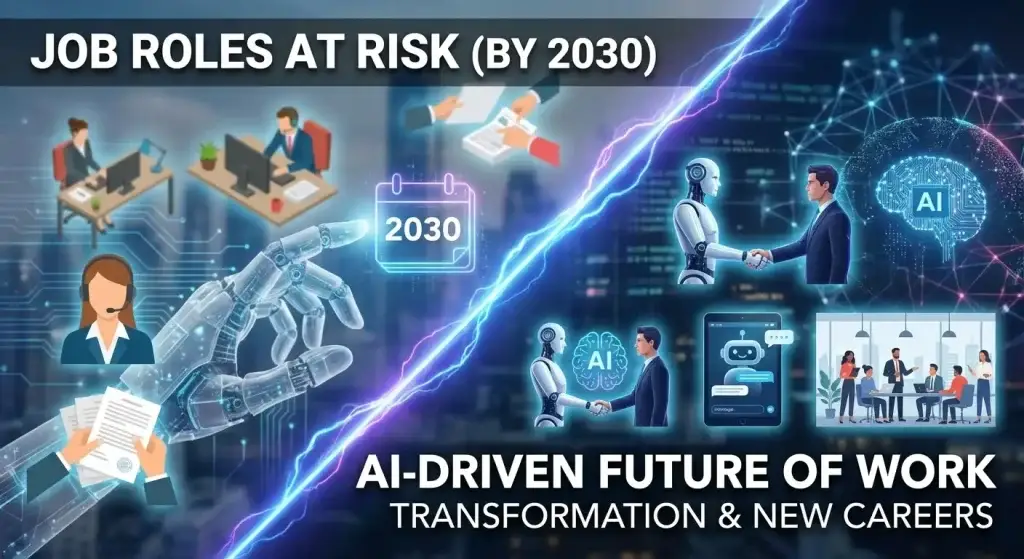
Artificial intelligence is no longer something we talk about as the future.
It is already here.
AI is answering customer questions, analyzing financial data, screening resumes, writing reports, managing schedules, and optimizing business decisions. What once felt experimental is now part of everyday work.
Because of this, one question keeps coming up everywhere.
What jobs will AI replace by 2030?
The honest answer is this.
AI will not replace all jobs.
But it will replace tasks, roles, and entire job categories that depend heavily on repetition, rules, and predictable patterns.
By 2030, many people will not lose work entirely, but their jobs will look very different. Some roles will shrink. Some will disappear. And many new roles will be created.
This article explains which jobs are most at risk, which industries will change the most, which roles are likely to survive, and how people can prepare for an AI driven future without panic.
Why AI Is Replacing Certain Jobs
AI is not intelligent in a human way. It does not think, feel, or understand meaning. What it does extremely well is process structured information, follow rules, recognize patterns, and repeat tasks without getting tired.
Jobs that involve clear instructions, predictable workflows, and historical data are the easiest to automate.
AI does not replace humans because it is smarter. It replaces specific tasks because it is faster, cheaper, and more consistent at them.
As companies focus on efficiency and scale, AI becomes a natural tool for handling routine work.
High Risk Jobs Likely to Be Replaced by AI by 2030
Administrative and Clerical Roles
Administrative work is one of the most vulnerable areas.
These roles often involve scheduling, data entry, document handling, and basic coordination. AI systems can already manage calendars, scan documents, extract data from forms, and automate office workflows.
Jobs most at risk include data entry clerks, receptionists, administrative assistants, office clerks, and records management staff.
By 2030, many offices will operate with much smaller administrative teams supported by AI platforms.
Customer Service and Call Center Jobs
Customer service is changing fast.
AI chatbots and voice assistants can now handle thousands of customer requests at the same time. Simple questions like order status, password resets, billing inquiries, and appointment scheduling are already handled by AI in many companies.
Roles most affected include call center agents, telemarketers, and customer support staff who deal mainly with basic questions.
Human agents will still be needed for complex, emotional, or sensitive situations, but most first level support will be automated.
Finance and Accounting Roles
AI is extremely strong at working with numbers.
It can reconcile accounts, generate reports, detect unusual transactions, and forecast trends faster than humans doing manual work.
Jobs at high risk include bookkeepers, accounting assistants, payroll clerks, and junior finance roles focused only on reporting.
Accountants who move into advisory, compliance, strategy, and decision support will remain valuable. Purely transactional roles will continue to decline.
Legal Support and Paralegal Work
The legal field is changing quietly but significantly.
AI tools can review contracts, scan legal documents, and find relevant case law in seconds. This directly affects roles focused on document review and legal research.
Paralegals, legal research assistants, and document review specialists are among the most disrupted roles.
Lawyers themselves are unlikely to disappear, but their work will shift toward judgment, negotiation, and strategy rather than paperwork.
Retail and Food Service Jobs
Retail has already seen major automation.
Self checkout systems, automated inventory management, online ordering, and smart kiosks are reducing the need for frontline staff.
Cashiers, store attendants, fast food order takers, and basic retail roles are among the most affected.
By 2030, many physical stores will operate with minimal staff supported by AI driven systems.
Media and Content Creation Roles
AI generated content has improved rapidly.
It can write basic articles, summarize information, proofread text, moderate content, and translate common languages.
Roles most at risk include proofreaders, basic copywriters, content moderators, and translators working with common language pairs.
However, storytelling, creative direction, brand voice, and deep journalism still require human understanding and originality.
Industries Facing Major Disruption by 2030
Transportation and Warehousing
Automation is transforming logistics.
Robotic warehouses, AI optimized inventory systems, and autonomous delivery technologies are reducing the need for manual labor.
Warehouse pickers, packers, inventory controllers, and dispatch roles will shrink. Human oversight will remain, but fewer workers will be needed overall.
Manufacturing and Assembly Lines
Manufacturing has been automating for decades, but AI powered robotics will accelerate this trend.
Assembly line workers, repetitive machine operators, and quality inspection roles are especially vulnerable.
Factories of the future will rely on small teams supervising intelligent machines rather than large manual workforces.
Sales and Marketing Operations
AI can analyze customer behavior, automate lead qualification, optimize pricing, and generate marketing content.
Sales development roles, market research positions, and routine marketing coordination tasks will change or decline.
Sales professionals focused on relationships, trust, and negotiation will remain essential.
Jobs AI Is Unlikely to Replace
Despite rapid automation, many jobs remain safe because they rely on human judgment, empathy, creativity, and adaptability.
Healthcare and Caregiving
Healthcare requires trust, emotional intelligence, and ethical responsibility.
Doctors, nurses, therapists, and elder care professionals will be supported by AI, not replaced by it.
Skilled Trades
Hands on trades require problem solving in unpredictable environments.
Electricians, plumbers, carpenters, and HVAC technicians remain difficult to automate and are expected to stay in demand.
Leadership and Management
Strategy, people management, and decision making under uncertainty are human strengths.
Business leaders, project managers, entrepreneurs, and policy makers will continue to play central roles.
reative and Design Roles
Creativity is more than generating output. It involves culture, emotion, and human experience.
UX designers, UI designers, brand strategists, product designers, and creative directors will use AI as a tool, not a replacement.
How Many Jobs Will AI Replace?
Estimates vary widely.
Some studies suggest AI could automate around 30 percent of work activities by 2030. Others estimate that nearly half of all job tasks could be automated by mid century.
But automation does not mean mass unemployment.
Every major technological shift has eliminated some jobs and created new ones. The real challenge is reskilling and transition, not the end of work.
What Jobs Will Be in Demand by 2030?
As routine work is automated, demand will grow for roles that build, manage, and guide AI systems.
High demand roles include AI specialists, data analysts, cybersecurity professionals, AI ethics experts, and digital transformation consultants.
At the same time, soft skills will become more valuable than ever.
Critical thinking, creativity, communication, emotional intelligence, and adaptability will separate humans from machines.
Will AI Replace Human Jobs Completely?
No.
AI does not have consciousness, moral judgment, or true understanding. It cannot fully grasp human emotion, social context, or ethical responsibility.
The future of work is not humans versus AI.
It is humans working with AI.
People who learn to use AI as a tool will outperform those who resist it.
How to Prepare for an AI Driven Job Market
The most important skill going forward is adaptability.
Workers who continue learning, updating skills, and staying aware of industry changes will remain valuable.
Practical steps include learning digital skills, understanding AI tools, strengthening problem solving abilities, and focusing on roles that involve human interaction.
Career resilience will matter more than staying in one fixed job.
Final Thoughts
By 2030, AI will replace many jobs built around repetition, data processing, and predictable workflows. Administrative work, basic customer service, bookkeeping, routine legal tasks, retail roles, and simple content creation will be most affected.
At the same time, AI will create new opportunities and elevate many professions. Jobs centered on creativity, empathy, strategy, and complex decision making will remain essential.
The key truth is simple.
AI is not here to remove humans from work.
It is here to remove tasks that machines do better.
Those who adapt, reskill, and learn to work alongside AI will not just survive.
They will thrive.