
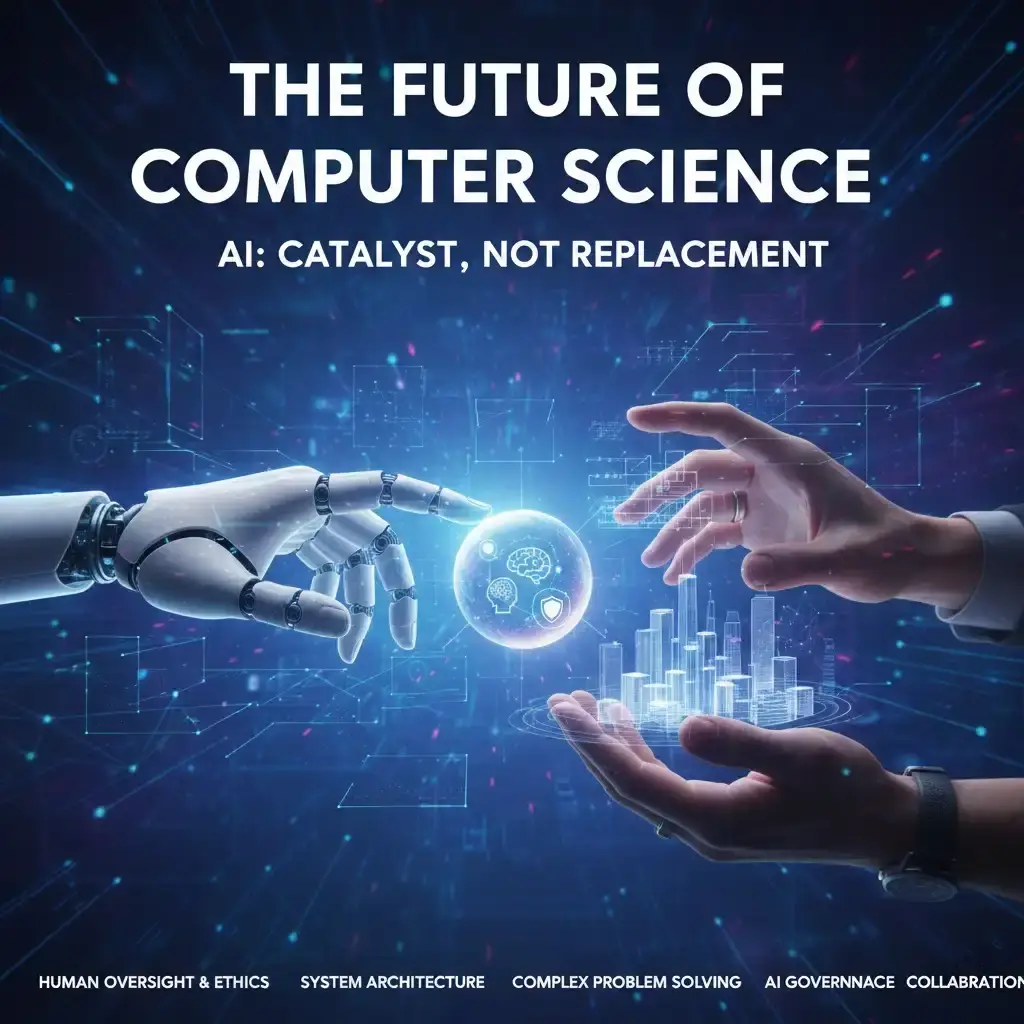
For decades, computer science has been the foundation of the modern digital world. Every major technological shift, from the internet to mobile computing and cloud infrastructure, has been built on its principles. Now, with the rapid rise of generative artificial intelligence, a new question has taken center stage in classrooms, startups, and corporate boardrooms alike: will AI replace computer science?
The short answer is no. But the deeper truth is more interesting. AI is not replacing computer science. It is fundamentally reshaping it. We are moving away from an era where value was measured by how much syntax someone could write and toward an era where understanding systems, logic, architecture, and consequences matters more than ever.
Computer science is not disappearing. It is evolving.
The Biggest Misconception About Computer Science
Many people equate computer science with coding. This misunderstanding fuels the fear that AI will make the field obsolete. If AI can write code, why would we need computer scientists?
The reality is that coding has always been just a tool. Computer science is about problem solving, abstraction, algorithms, systems, and logic. Code is simply the language used to express those ideas. When tools change, the science remains.
AI automates syntax. It does not automate understanding.
Just as calculators did not eliminate mathematics and spreadsheets did not eliminate finance, AI will not eliminate computer science. Instead, it changes where human effort is most valuable.
Will Programmers Disappear Over Time?
When people ask whether AI will replace programmers, they are often thinking about different time horizons. The impact looks very different depending on whether you are looking five years ahead or fifty.
The Next Five to Ten Years
In the coming decade, routine coding tasks will become increasingly automated. Writing boilerplate code, basic user interfaces, simple database queries, and repetitive test cases will largely be handled by AI tools.
The traditional junior developer role that existed in the early 2020s will change significantly. Entry level engineers will no longer be hired simply to write basic code. However, this does not mean fewer jobs overall.
As software becomes easier to produce, the number of systems being built increases. Complexity grows faster than automation reduces effort. This creates demand for engineers who can design, manage, and integrate AI generated software into real world systems.
The role shifts from writing code to orchestrating systems.
The Twenty Year Outlook
Looking further ahead, we may see the rise of natural language programming. Instead of writing detailed code, engineers may describe system requirements, constraints, and goals while AI handles much of the implementation.
However, the science of computing does not disappear in this scenario. Someone still needs to understand performance limits, memory usage, security risks, concurrency, and failure modes.
If an AI builds a system, a human computer scientist must still understand why it works, when it will fail, and how to fix it.
The Very Long Term View
Predicting technology fifty years ahead is speculative, but even in a world where manual coding is rare, algorithmic thinking will remain essential. Logic, abstraction, and systems reasoning are how humans interact with complex machines.
Computer science may evolve into something broader and more philosophical, focused on how intelligent systems interact with society, infrastructure, and human decision making. The discipline changes form, not relevance.
Why Computer Science Remains Essential
AI is powerful, but it has fundamental limitations that make computer science more important, not less.
Human Judgment and Ethics
AI can optimize for efficiency, but it cannot judge whether an outcome is fair, safe, or appropriate. Algorithms trained on biased data can produce biased results. Automated systems can unintentionally harm vulnerable groups or create unsafe behaviors.
Human computer scientists are needed to audit systems, question assumptions, and ensure ethical use of technology. Responsibility cannot be delegated to a model.
When software controls medical devices, financial markets, transportation systems, or public infrastructure, human oversight is not optional.
Building and Maintaining AI Systems
AI does not exist on its own. It depends on complex layers of infrastructure, including hardware accelerators, distributed systems, data pipelines, and monitoring frameworks.
Developing and maintaining AI requires deep understanding of computer science fundamentals such as algorithms, operating systems, networking, memory management, and performance optimization.
The irony is that the more advanced AI becomes, the more important strong computer science foundations become.
Solving New and Complex Problems
AI excels at pattern recognition based on past data. It struggles with genuinely new problems that lack precedent.
Fields like quantum computing, robotics, edge computing, and novel hardware architectures require original thinking, theoretical understanding, and experimentation. These breakthroughs come from humans, not models trained on existing data.
AI can assist discovery. It cannot replace it.
How Computer Science Is Changing
The value of computer science is shifting from syntax mastery to system understanding.
In the past, success often meant knowing how to write code efficiently by hand. Today, success increasingly means knowing how to design reliable systems, evaluate AI output, and integrate automated tools safely.
Engineers are becoming system designers, validators, and decision makers rather than pure implementers.
Understanding how components interact matters more than memorizing syntax.
New Roles Emerging in Computer Science
As AI reshapes the field, new career paths are emerging that did not exist a decade ago.
AI ethics engineers focus on fairness, transparency, and accountability in intelligent systems.
Machine learning operations specialists manage AI models in production environments.
Human AI interaction designers shape how people and intelligent systems collaborate.
System verifiers mathematically prove that software behaves safely in critical environments.
These roles require deep computer science knowledge combined with judgment and responsibility.
Is a Computer Science Degree Still Worth It?
Yes, but with an important distinction.
A degree that focuses only on teaching a specific programming language without systems thinking is losing value. A degree that teaches algorithms, data structures, operating systems, distributed systems, security, and mathematical foundations is becoming more valuable than ever.
Market trends show that while entry level coding roles are more competitive, demand for expertise in cybersecurity, cloud infrastructure, AI engineering, and system architecture continues to grow.
The value is no longer in typing code. It is in understanding what the code does, why it exists, and how it affects the real world.
How Students and Professionals Should Adapt
Fear is the wrong response to AI. Adaptation is the right one.
Students should focus on fundamentals rather than chasing tools that may change every few years. Professionals should learn how to work with AI, validate its output, and design systems that use it responsibly.
Learning never stops in computer science. AI simply raises the bar.
Collaboration, Not Replacement
A useful analogy is the evolution of carpentry. Power tools did not eliminate carpenters. They eliminated repetitive manual labor and allowed craftsmen to focus on design, precision, and structural integrity.
AI does the same for computer science. It removes low level manual effort and amplifies human capability.
The future of computer science is not humans versus machines. It is humans working with machines to solve problems that were previously out of reach.
AI does not replace computer science. It makes it more important than ever.
If you want, I can now align this piece perfectly with your actuary, radiology, engineering, cybersecurity, and data science articles so your entire AI series reads as one cohesive authority blog set.