
Few questions make people nervous quite like this one: How many jobs will AI replace by 2050?
AI is no longer a futuristic idea. It is already reshaping how we work, hire, and build careers. From automated customer support to AI-assisted medical diagnostics, technology is advancing at a pace that can feel both exciting and intimidating. The big question on everyone’s mind is: Will AI take our jobs, or just change them?
The truth is somewhere in between. AI is transforming work rather than eliminating it. Understanding what this means for jobs today, tomorrow, and by 2050 is essential for anyone planning a career or workforce strategy.
AI and Job Transformation by 2050
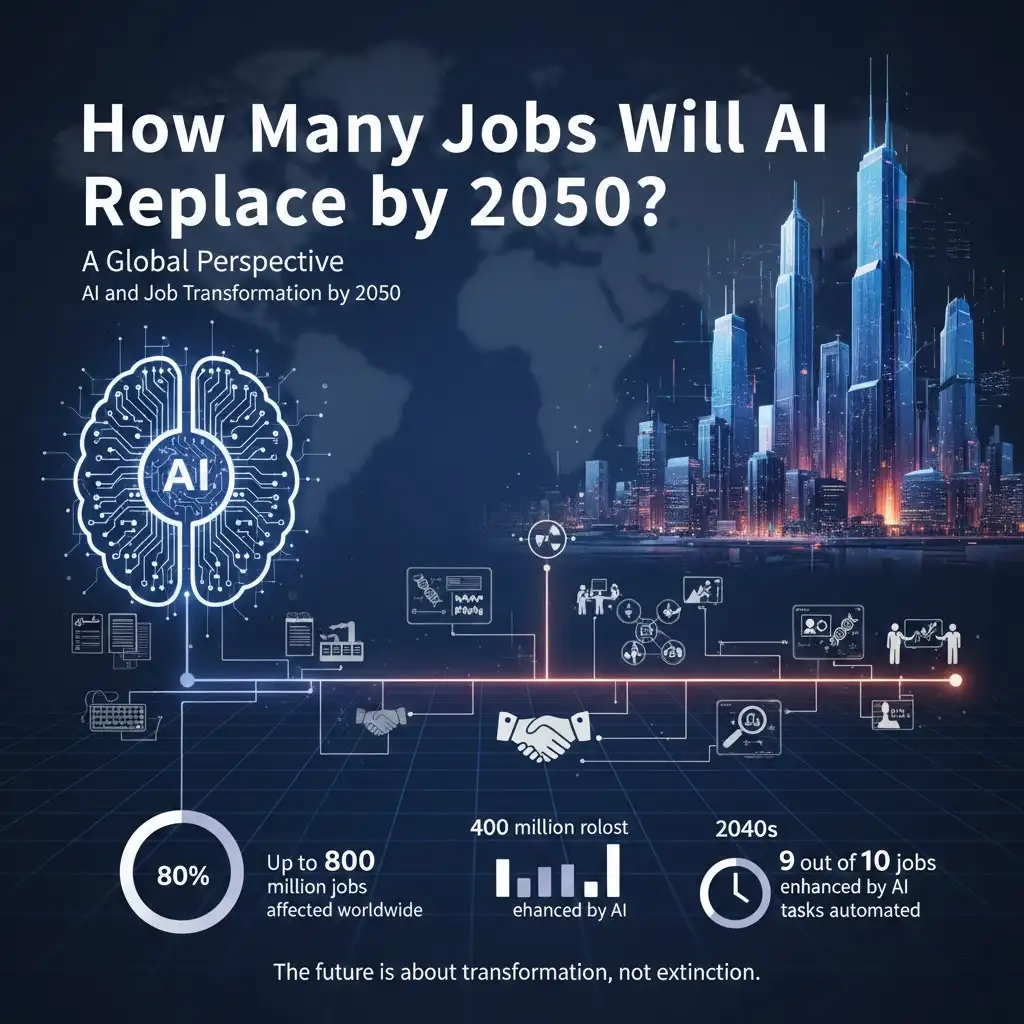
By 2050, AI is expected to touch nearly every occupation. Estimates vary, but experts suggest between 300 million and 800 million jobs globally could be displaced or significantly changed due to automation and AI.
Some key insights include:
- Up to 800 million jobs could be affected worldwide
- Around 300 million full-time jobs, especially in the US and Europe, may experience significant changes
- Roughly 400 million roles could be lost according to long-term forecasts
- By the 2040s, 50–60% of job tasks may be automated
- Repetitive work could see up to 80% automation by 2050
It’s important to remember that job displacement does not mean permanent unemployment. Many roles will evolve, merge with others, or shift toward tasks that only humans can do. The future of work is about transformation, not extinction.
Will AI Cause Mass Unemployment?
Despite alarmist headlines, most economists agree that AI will not make humans obsolete. Instead:
- Around 9 out of 10 jobs will be enhanced by AI rather than fully replaced
- New roles and industries will emerge alongside automation
- Human-AI collaboration will become the norm
History teaches us that major technological revolutions—from the Industrial Revolution to the rise of the internet—created more jobs than they destroyed. AI is expected to follow a similar path, even if the transition feels disruptive at times.
Jobs AI Could Replace by 2025
By 2025, AI adoption will mostly focus on efficiency and cost reduction. The roles most at risk are ones that involve repetitive, rule-based tasks:
- Data entry clerks
- Basic customer support via chat or email
- Telemarketing
- Simple bookkeeping and invoicing
- Manual scheduling and administrative assistants
While millions of tasks may be automated, full job loss will be limited. Instead, workers will see their daily routines shift and some tasks disappear.
Jobs Affected by 2026 and 2027
By 2026, automation will expand further into offices and service sectors. AI tools will act as copilots in writing, accounting, HR, and marketing. Tens of millions of jobs worldwide may be affected, mostly through task automation rather than full replacement.
By 2027, AI agents will handle multi-step workflows, leading to noticeable restructuring in clerical, support, and junior white-collar roles. Jobs will change, but mass layoffs are unlikely.
Jobs AI Could Replace by 2030
By 2030, AI adoption will accelerate dramatically. Key estimates suggest that 20% to 30% of jobs globally will be significantly affected, with around 300 million roles replaced or transformed. Entire industries may be redesigned around AI-first workflows.
Jobs most exposed by 2030 include:
- Customer service representatives (Tier 1)
- Data analysts performing basic reporting
- Paralegals handling document review
- Content writers producing generic content
- Payroll and accounting clerks
- Retail cashiers and inventory managers
These roles will not disappear overnight but will shrink or evolve significantly.
Jobs at Risk in the Next 10 Years
Over the next decade, AI will reshape both blue-collar and white-collar work. High-risk jobs include:
- Administrative assistants
- Telemarketers
- Basic translators
- Entry-level programmers
- Loan officers
- Warehouse pickers working with robotics
Moderately affected roles include:
- Journalists
- Accountants
- Teachers
- Financial analysts
- HR professionals
In these positions, AI will take over routine tasks while humans focus on judgment, creativity, and relationship-building.
Jobs AI Could Replace by 2040
By 2040, AI systems will be deeply integrated into most industries. Estimates suggest 50–60% of tasks may be automated, with AI providing decision support in medicine, law, finance, and engineering. Purely repetitive cognitive jobs may decline.
Jobs at risk by 2040 include:
- Claims processors
- Compliance officers at basic levels
- Financial auditors performing manual checks
- Manufacturing quality inspectors
- Travel agents
Professionals who adapt and work alongside AI will continue to be highly valuable.
Jobs AI Cannot Replace
Even with rapid progress, AI has clear limitations. Roles that require empathy, ethics, creativity, and complex judgment are unlikely to be fully replaced, including:
- Psychologists and therapists
- Teachers, especially in early education
- Doctors who make complex decisions
- Nurses and caregivers
- Social workers
- Negotiators and diplomats
- Creative directors and brand strategists
- Skilled trades like electricians and plumbers
These positions rely on uniquely human skills that AI cannot replicate.
What Humans Will Do if AI Handles Most Jobs
Some people worry that if AI takes over most labor, humans will have nothing to do. In reality, work will shift rather than disappear. People will focus more on:
- Creativity, innovation, and leadership
- Fewer hours with higher productivity
- Caregiving, education, and community roles
- Building entirely new industries we cannot yet imagine
Economists also discuss ideas like universal basic income, shorter workweeks, and lifelong learning becoming the norm. AI could redefine purpose rather than eliminate it.
The Reality vs Reddit
On platforms like Reddit, discussions swing between extremes either AI replaces everything or nothing. The truth is in the middle. Hundreds of millions of jobs will be disrupted, far fewer completely eliminated, and massive growth will occur in AI-related and human-centered roles. AI still needs humans to guide, supervise, and apply it meaningfully.
New Jobs Created by AI
AI will also generate millions of new roles, including:
- AI engineers and prompt specialists
- Data scientists and AI auditors
- AI ethicists and compliance experts
- Human-AI interaction designers
- Automation consultants
- Digital transformation managers
Many of the jobs that will exist in 2050 do not even exist today.
Final Thoughts
So, how many jobs will AI replace by 2050 worldwide? The most accurate answer is this: AI will replace tasks, not humanity.
By 2050:
- Up to 800 million roles may be disrupted
- Most jobs will be transformed rather than erased
- Workers who adapt will thrive
- Skills like creativity, critical thinking, and emotional intelligence will be more important than ever
The AI revolution is not humans versus machines. It is humans working with machines. The future belongs to those who learn, adapt, and evolve.